

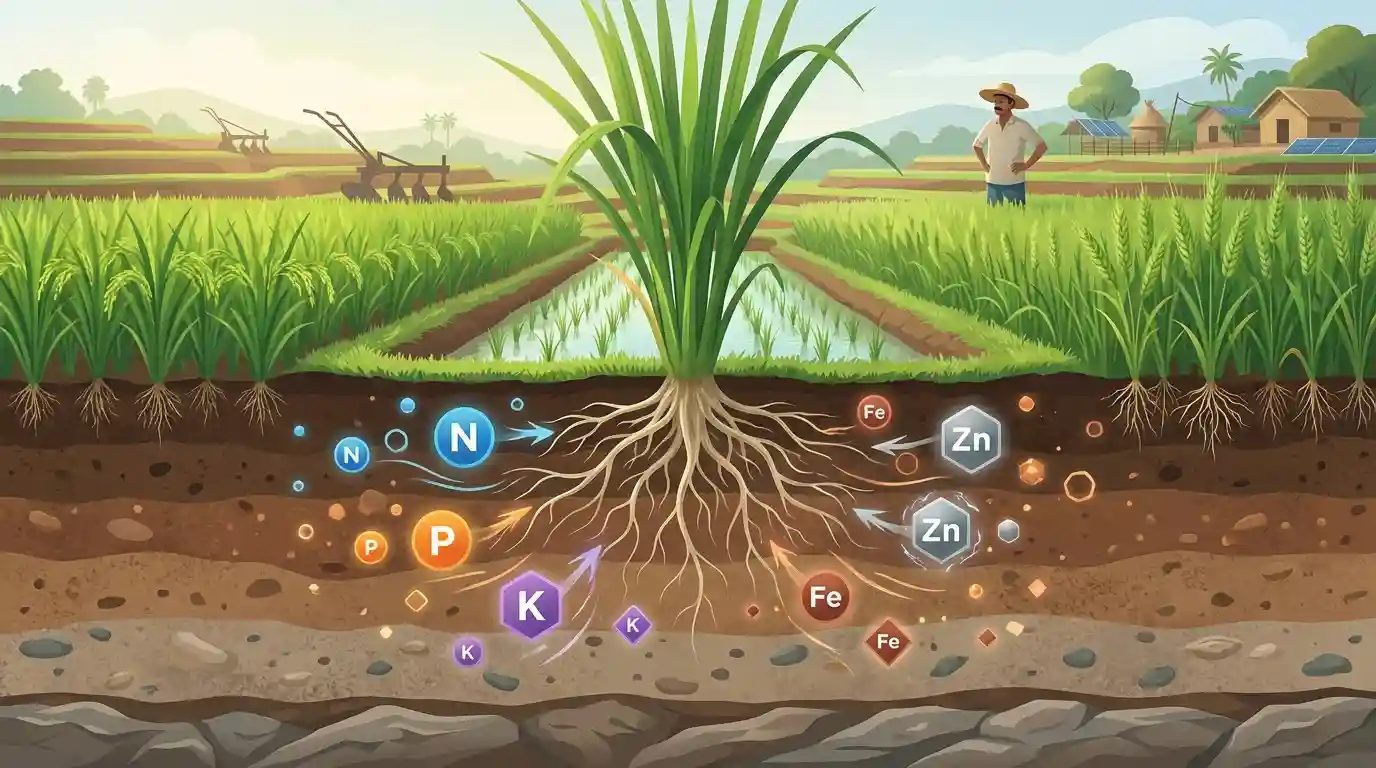
Introduction to Plant Nutrients
Plant nutrients are essential elements that plants need to grow, develop, reproduce, and complete their life cycle. Just like humans need balanced food, crops also require the right nutrients in proper amounts. These nutrients are mainly absorbed by plant roots from the soil in the form of inorganic ions, which may carry positive or negative charges.
Proper nutrient supply directly influences:
- Crop yield
- Grain and fruit quality.
- Resistance to pests, diseases, and stress.
In Indian farming systems, nutrient imbalance is a common reason for low productivity, especially in cereals, pulses, and vegetable crops.
This topic is part of our Agronomy Notes for agriculture students.
Minerals and Mineral Nutrients
What Are Minerals?
Minerals are natural chemical elements that originate from soil and rocks. They become available to plants after weathering and dissolution in soil water.
What Are Mineral Nutrients?
Mineral nutrients are plant nutrients whose main source is soil and which are absorbed by roots through the soil solution. These nutrients play a direct role in plant metabolism and structure.
Total Essential Plant Nutrients
Plants require 17 essential nutrients for normal growth and reproduction. If even one essential nutrient is missing, the plant cannot complete its life cycle properly.
Classification of Essential Nutrients
1. Based on Source
A. Non-Mineral Nutrients (3)
These nutrients are obtained from air and water, not from soil:
- Carbon (C) from CO2
- Hydrogen (H) from water
- Oxygen (O) from air and water
Together, these three elements form 90–96% of plant dry matter, especially carbohydrates and organic compounds.
B. Mineral Nutrients (14)
These nutrients come from soil and rocks:
- Nitrogen (N)
- Phosphorus (P)
- Potassium (K)
- Calcium (Ca)
- Magnesium (Mg)
- Sulphur (S)
- Iron (Fe)
- Manganese (Mn)
- Zinc (Zn)
- Copper (Cu)
- Boron (B)
- Molybdenum (Mo)
- Chlorine (Cl)
- Nickel (Ni)
👉 Nickel (Ni) is the most recently identified essential nutrient, discovered by P. F. Brown in 1987.
2. Classification Based on Requirement
A. Basic Elements
- Carbon, Hydrogen, Oxygen
Form the structural backbone of plant tissues.
B. Macronutrients
Required in large quantities (more than 50 ppm in plant dry matter).
1. Primary Macronutrients
Nitrogen (N) – vegetative growth
Phosphorus (P) – root and seed development
Potassium (K) – disease resistance and quality
These nutrients are heavily used in Indian crops like wheat, rice, maize, and sugarcane.
2. Secondary Macronutrients
Calcium (Ca), Magnesium (Mg), Sulphur (S)
These are often supplied through lime, gypsum, and sulphur-containing fertilizers.
General Uptake Order (Macronutrients)
N > K > Ca > Mg > P > S
C. Micronutrients
Required in very small amounts (less than 50 ppm), but deficiency can severely affect crops.
- Iron (Fe)
- Manganese (Mn)
- Zinc (Zn)
- Copper (Cu)
- Boron (B)
- Molybdenum (Mo)
- Chlorine (Cl)
- Nickel (N
General Uptake Order
Cl > Fe > Mn > B > Zn > Cu > Ni > Mo
Molybdenum is required in extremely minute quantity.
3. Classification Based on Mobility in Plants
Mobility refers to the ability of nutrients to move from old leaves to new growing parts.
A. Highly Mobile Nutrients
- Nitrogen (N)
- Phosphorus (P)
- Potassium (K)
- Magnesium (Mg)
- Molybdenum (Mo)
➡ Deficiency symptoms appear first in older leaves.
B. Moderately Mobile
- Zinc (Zn)
C. Less Mobile Nutrients
- Iron (Fe)
- Copper (Cu)
- Sulphur (S)
- Manganese (Mn)
- Chlorine (Cl)
- Nickel (Ni)
D. Immobile Nutrients
- Calcium (Ca)
- Boron (B)
➡ Deficiency symptoms appear in young leaves and growing points, common in crops like cauliflower and groundnut.
Optimum Soil pH for Nutrient Availability
| Nutrient | Suitable Soil pH |
|---|---|
| Nitrogen (N) | 6.5 – 7.5 |
| Phosphorus (P) | 6.0 – 6.5 |
| Potassium (K) | 6.5 – 8.0 |
| Calcium & Magnesium | Above 7.5 |
| Sulphur (S) | 6.5 – 7.5 |
Micronutrients and Soil pH
- Most micronutrients are more available in acidic soils.
- Molybdenum availability increases in alkaline soils.
This is why zinc deficiency is common in alkaline soils of Indo-Gangetic plains.
Criteria for Essentiality of Plant Nutrients
The concept of essential nutrients was proposed by Arnon and Stout (1939) and later refined by Arnon (1954).
A nutrient is essential if:
- In the absence of an element, it is not possible to plant for vegetative & reproductive life cycle.
- Its role cannot be replaced by another element. Elements should be specific.
- It plays a direct role in plant metabolism.
Essentiality is proven through controlled experiments.
Plant Nutrition Process
Plant nutrition involves three main steps:
- Absorption
- Translocation
- Assimilation
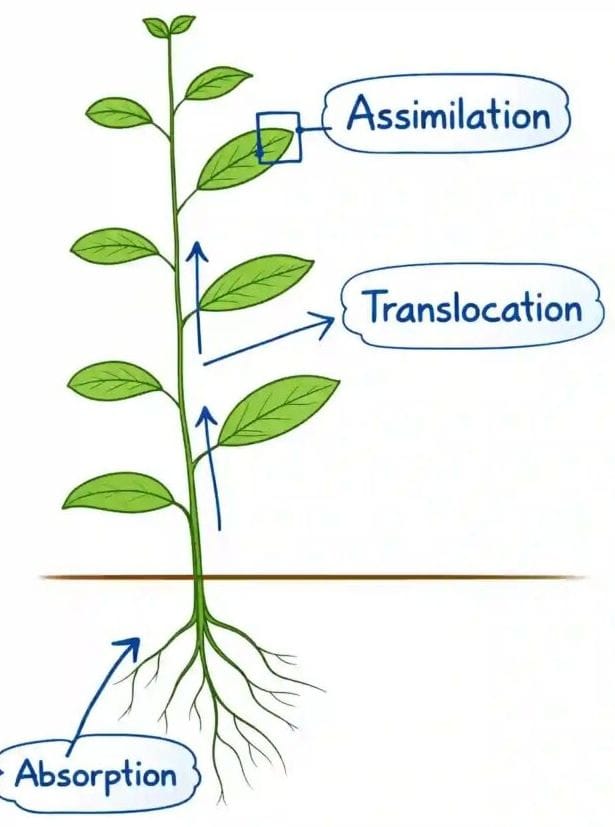
1. Absorption of Nutrients
Absorption is the process by which plant roots take up nutrients from the soil solution.
Mechanism of Absorption
a. Active Absorption :- Absorption of nutrients from soil solution containing low concentration of nutrients composed of plant sap, by spending energy called Active absorption.
b. Passive Absorption :- nutrients enter the plant along with a transpiration stream without the use of energy.
2. Translocation of Nutrients
Translocation is a movement of nutrients. In which Xylem transports water and mineral nutrients from roots to leaves and Phloem transports food materials from leaves to other plant parts.
3. Assimilation of Nutrients
Assimilation is the process by which absorbed inorganic nutrients are converted into organic compounds within the plant.
The term assimilation literally means “to make similar”, indicating conversion into plant body substances.
Example: Carbon dioxide, water, and nitrates are converted into carbohydrates, proteins, and other compounds.
Plant Nutrients Part-2👉 For a better understanding of plant nutrition, also read our detailed notes on the functions of plant nutrients and their deficiency symptoms, explained clearly with examples and diagrams.
Frequently Asked Questions (FAQs) on Plant Nutrients
What are plant nutrients?
Plant nutrients are essential chemical elements required by plants for growth, development, reproduction, and completion of their life cycle.
How many essential plant nutrients are required by plants?
Plants require 17 essential nutrients. The absence of even one essential nutrient can disturb normal plant growth and reproduction.
What is the difference between mineral and non-mineral nutrients?
Non-mineral nutrients (Carbon, Hydrogen, Oxygen) are obtained from air and water, while mineral nutrients are absorbed from soil through plant roots.
What are macronutrients and micronutrients?
Macronutrients are needed in large amounts (like Nitrogen, Phosphorus, Potassium), whereas micronutrients are required in very small quantities but are equally important for plant health.
Why are micronutrients important for plants?
Micronutrients help in enzyme activation, chlorophyll formation, and metabolic processes. Their deficiency can cause serious growth disorders even in small amounts.
What is nutrient mobility in plants?
Nutrient mobility refers to the ability of nutrients to move from older plant parts to younger growing tissues inside the plant.
Download Notes | PDF format👇
These handwritten, exam-oriented notes are available only for registered students.To download the PDF, please register or log in first.


Leave a Reply