

In agriculture, we don’t just grow crops randomly. Farmers decide which crop to grow, when to grow it, and in what order. That planning is called the cropping pattern and cropping system.
This topic is very important for B.Sc. Agriculture students and for exams like ICAR, CUET, NABARD and AFO.
Let’s understand it step by step in a simple way.
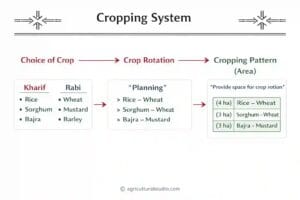
In the figure, first we choose a crop according to the season, then make a plan, and finally allocate the area to the crop. This is called the cropping pattern.
Cropping Pattern + Management= Cropping System
This topic is part of our Agronomy Notes series for agriculture students.
Cropping Pattern
Cropping pattern means the yearly sequence and spatial arrangement of crops grown on a particular piece of land, it’s called Cropping pattern.
It tells us:
✓Which crops are grown during the year.
✓And how they are placed in the field.
Example: In most of North India, farmers follow Rice in Kharif season and Wheat in Rabi season. This is a typical cropping pattern.
When this pattern is managed scientifically, it becomes a cropping system.
Cropping System
A cropping system is simply the order in which crops are grown on the same land over a fixed time period.
The aim is:
✓To use land, water, and fertilizers efficiently.
✓And to get higher profit and stable production.
Types of Cropping System
1. Monocropping
Growing only one crop in a year on the same land.
This is common in rainfed areas where irrigation is limited.
Examples:
✓Bajra followed by fallow land
✓Sorghum followed by fallow
✓Fallow followed by mustard
👉Monoculture
Repetitive growing of only one crop on the same piece of land year after year.
Example: Rice — Rice — Rice
2. Multiple Cropping
In multiple cropping, two or more crops are grown on the same land within one year.
The most common example in India is:
✓Rice → Wheat
Prerequisites for Multiple Cropping
- Irrigation facilities must be available.
- Short duration crop varieties are required.
- Crops should be thermo- and photo-insensitive.
- Mechanized cultivation is preferred.
- Adequate labor and money should be available.
- Timely availability of inputs (seed, fertilizer, pesticides).
Types of Multiple Cropping
1. Mixed Cropping
Mixed cropping means growing two or more crops together without any fixed row arrangement.
Example: Berseem + Mustard
The main drawback of mixed Farming is that harvesting becomes difficult because the crops are mixed.
2. Intercropping
Intercropping is the practice of growing two or more crops together in a definite row arrangement.
This method is widely practiced in India because it helps in better use of space and nutrients.
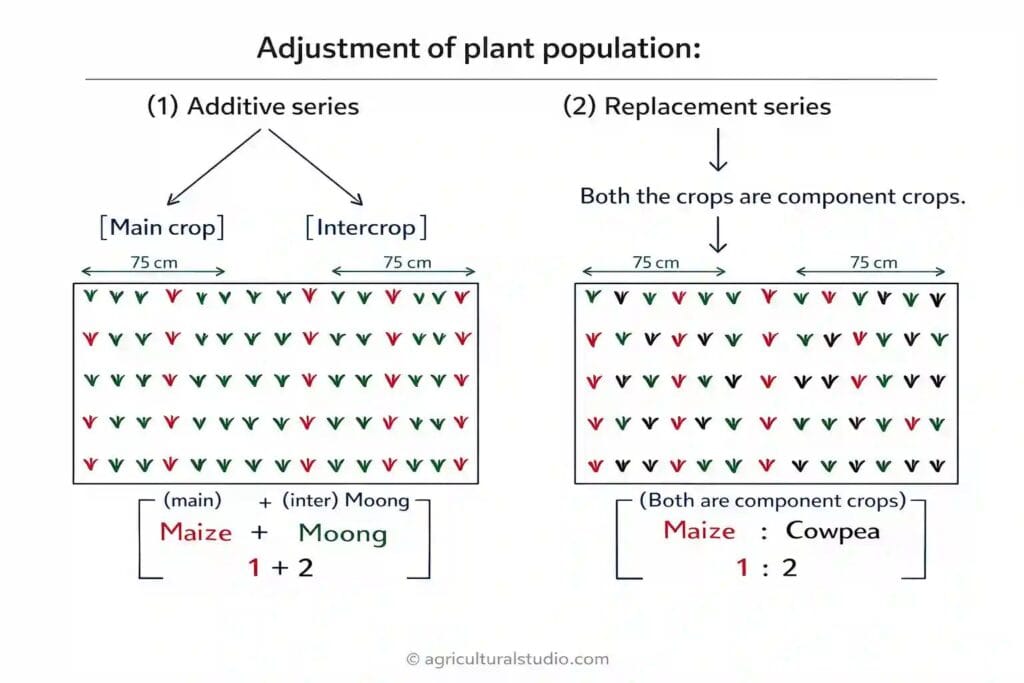
Two ways are used to adjust the plant population:
(a) Additive Series:
When inter crop Grown between the Main crop, It’s called an additive series population of inter cropping.
Example: Maize + Moong
(b) Replacement Series:
When Both crops are main crop(component crops) called the Replacement series.
Example: Maize + Cowpea
Methods of Intercropping
- Row Intercropping
- Patch Intercropping
- Strip Intercropping
- Multistoried Cropping
- Alley Intercropping
1. Row Intercropping
Growing two or more crops in rows, where at least one crop is planted in lines.
Mostly practiced in India.
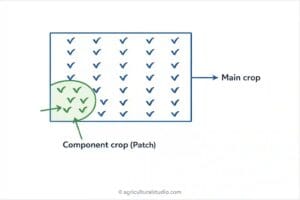
2. Patch Intercropping
Component crops are grown in small patches within the same field. Generally, it’s done when some area of field crop is damaged due to Pest, Disease or any other activity.
Mainly followed for vegetable crops.
3. Strip Intercropping
Crops are grown in alternate strips to reduce soil erosion.
✓ Erosion-permitting crops (E.g.- Cotton, Maize)
✓ Erosion-resistant crops (E.g.- Legumes)
4. Multistoried Cropping
Different crops are grown at different height levels, usually in plantation systems.
Examples:
✓ Sugarcane + Mustard + Onion
✓ Arecanut + Banana + Pineapple
✓ Coconut + Black Pepper + Cocoa + Pineapple
5. Alley Cropping
Growing crops such as jowar, maize, bajra or other arable crops between rows of leguminous shrubs (like Subabul).
6. Relay Cropping
Sowing the next crop(Succeeding crop) before harvesting the previous crop(Proceeding crop).
✓ It should be Done 7–10 days before harvesting.
✓ Also called Paira or Utera Cropping.
Systems of Intercropping
(a) Parallel Cropping
Growing crops with different natural habits that do not compete with each other(Zero competition).
(b) Companion Cropping
Growing crops together where the total production equals the yield of the crops grown separately.
(c) Synergetic Cropping
Both crops together give higher yield than of their pure crops on unit area basis.
Example:
Sugarcane + Potato
3. Sequential Cropping
Sequential cropping and crop rotation look almost the same, but it’s not.
Sequential cropping is a type of crop rotation, focusing on growing multiple crops within the same year (one after another) to maximize land use.
While crop rotation is a broader, long-term strategy of rotating different crops over seasons or years to improve soil health and manage pests.
Types of Sequential Cropping
| Type | Crops per Year | Example |
|---|---|---|
| Double Cropping | 2 | Rice → Wheat |
| Triple Cropping | 3 | Rice → Wheat → Moong |
| Quadruple Cropping | 4 | 4 crops in a year |
Download Notes | PDF format👇
These handwritten, exam-oriented notes are available only for registered students.To download the PDF, please register or log in first.
Some Important questions of Cropping pattern and cropping system
What is cropping pattern?
It is the yearly sequence and spatial arrangement of crops grown on the same land.
What is cropping system?
It is the planned order in which crops are grown on a particular field over time.
What is multiple cropping
Growing two or more crops in one year on the same land.
What is mixed cropping?
Growing two or more crops together without row arrangement
What is intercropping?
Growing two or more crops together with proper row arrangement.
What is relay cropping?
Sowing the next crop before harvesting the previous crop.
What is crop rotation?
Growing different crops on the same land in a planned and repeated order.
What is multistoried cropping?
Growing crops of different heights together on the same land.
What is alley cropping?
Growing field crops between rows of leguminous trees or shrubs.
What are the main principles of crop rotation?
Legume before non-legume, deep rooted after shallow rooted, high water crop before low water crop.
Difference Between Monoculture and Monocropping
Growing only one crop in a year on the same land called Monocropping.
Repetitive growing of only one crop on the same piece of land year after year called Monoculture.

Leave a Reply