

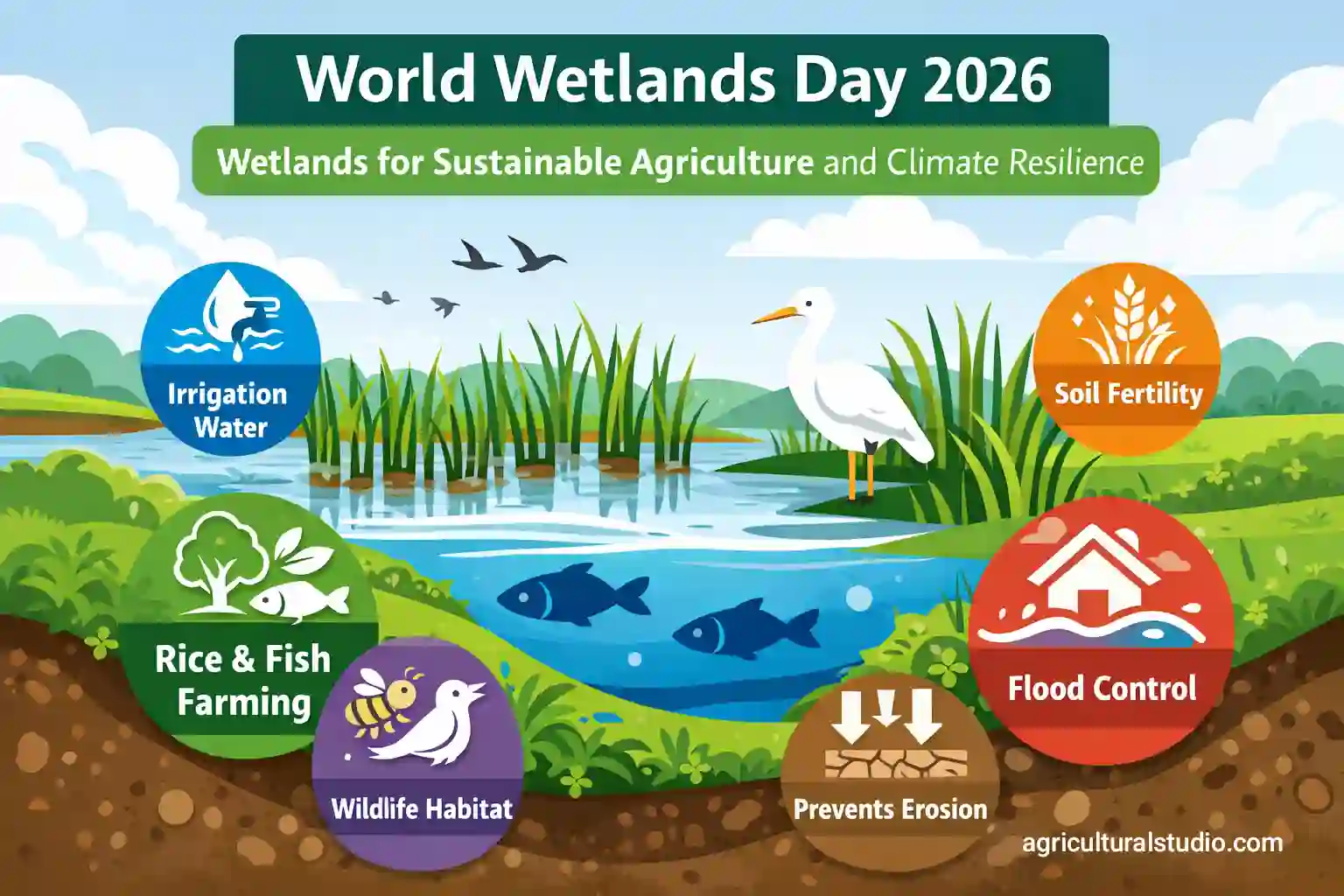
Every year on 2nd February, the world observes World Wetlands Day.
This day is not just about protecting lakes or ponds. It is about protecting the foundation of agriculture and food security.
Wetlands are like natural support systems for farmers.
They give water, improve soil, control floods, and support fish and wildlife. In 2026, the main message is clear:
👉 If we protect wetlands, we protect agriculture.
Table of Contents
World Wetlands Day 2026 Theme
Theme:
“Wetlands for Sustainable Agriculture and Climate Resilience“
This theme highlights:
- How wetlands help farmers cope with climate change
- How they ensure stable water supply and soil fertility
- How they support sustainable and eco-friendly farming
We can understand in short, conserving wetlands today means food security and farm stability tomorrow.
What are Wetlands?
Wetlands are land areas that remain covered with water, either for the whole year or for some part of the year.
You can easily imagine wetlands as:
- Lakes and ponds
- Marshy lands
- Riverbanks
- Swamps
- Paddy fields (yes, rice fields are also wetlands)
In simple words:
👉 Wetlands are places where land and water meet.
These areas support both crops and aquatic life, which makes them very important for agriculture.
Why is World Wetlands Day Celebrated?
This day celebrates the Ramsar Convention signed in 1971. This agreement was made to protect wetlands worldwide.
Main Goals:
- Protect natural water sources
- Promote sustainable farming
- Support farmers’ income
- Maintain biodiversity
- Prevent environmental damage
So, that this day reminds us that wetlands are not waste lands they are productive lands for farmers.
Importance of Wetlands in Agriculture
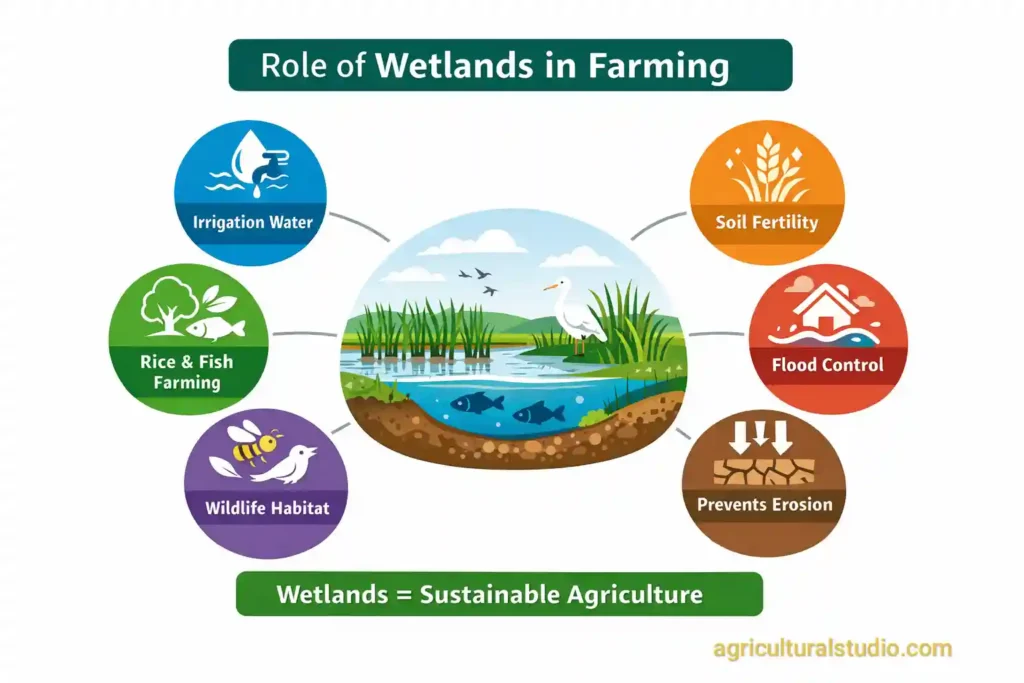
1. Wetlands Provide Irrigation Water
Wetlands act as natural water storage tanks. During the rainy season, they collect water.
In summer, farmers use this stored water for irrigation.
Benefits for farmers:
- Reduces dependence on tube wells
- Provides water in drought-prone areas
- Saves electricity and diesel
- Ensures crop survival in dry spells
For Example: In Punjab and Haryana, wetlands near rivers help farmers irrigate wheat and
2. Wetlands Improve Soil Fertility
Wetlands deposit rich nutrients and organic matter into the soil. This makes the soil more fertile, Better in structure, rich in organic carbon. That’s why rice fields stay productive for years.
For Example: In Kerala’s Kuttanad region, farmers grow rice below sea level because the soil is very fertile due to wetlands.
3. Wetlands Support Rice and Fish Farming Together
Wetlands allow farmers to practice Integrated Farming Systems. Farmers can grow:
- Paddy + Fish
- Paddy + Ducks
- Paddy + Vegetables
This gives extra income without needing extra land.
For Example: In West Bengal and Assam, farmers grow rice and rear fish in the same field.
4. Wetlands Control Flood and Soil Erosion
Wetlands absorb excess rainwater like a sponge. When there is heavy rainfall, wetlands soak up excess water instead of letting it rush into farms.
This helps to:
- Prevent floods
- Protect standing crops
- Reduce soil erosion
- Maintain soil nutrients
For Example:The Brahmaputra floodplains act as wetlands and protect farmlands from heavy floods.
5. Wetlands Support Beneficial Insects and Birds
Wetlands are not just water bodies. They are living ecosystems.They provide shelter and food to many useful organisms that support farming naturally.
Wetlands are home to:
- Pollinators (like bees)
- Natural pest-controlling birds
- Frogs and fish that eat harmful insects
This reduces the need for chemical pesticides.
For Example: In paddy fields of Tamil Nadu and Andhra Pradesh, frogs and birds control pests naturally.
6. Wetlands Help Regulate Climate Around Farms
Wetlands help maintain moisture in the air and keep the surrounding area cooler. This creates a comfortable environment for crops, especially during hot weather.
Wetlands protect crops from:
- Heat stress
- Sudden temperature changes
- Effects of dry spells
For example:Wetlands near agricultural fields in Odisha and Bihar help rice crops survive high temperatures during the summer months.
Major Wetlands in India and Their Agricultural Role
| Wetland | State | Importance for Agriculture |
|---|---|---|
| Chilika Lake | Odisha | Fish farming & irrigation |
| Loktak Lake | Manipur | Floating agriculture |
| Vembanad Lake | Kerala | Rice cultivation |
| East Kolkata Wetlands | West Bengal | Wastewater-based farming |
| Harike Wetland | Punjab | Supports irrigation |
What Happens When Wetlands are Destroyed?
Loss of wetlands leads to serious agricultural problems.
Major Impacts
✓ Water shortage for crops
✓Reduced soil fertility
✓Decline in fish production
✓ Increase in floods and droughts
✓ Loss of beneficial insects and birds
✓ Farmers’ income decreases
This is why wetland conservation is directly linked to farmer prosperity and food security.
How Farmers Can Help Protect Wetlands
Wetland conservation does not start in offices or policies. It starts from the farmer’s field and the village pond.
Farmers can protect wetlands by following some simple and practical steps:
- Avoid throwing plastic, chemicals, or farm waste into ponds and lakes.
- Use compost, green manure, and organic fertilizers instead of excess chemicals.
- Do not over-pump water from nearby wetlands.
- Protect village ponds, canals, and natural water channels.
- Practice integrated farming like rice–fish culture.
- Grow trees and grasses around wetland boundaries.
When farmers take care of wetlands, wetlands take care of farming. This balance is the key to long-term agricultural success.
How Wetlands Support Sustainable Agriculture
Sustainable agriculture means farming that can continue for many years without harming soil, water, or nature. Wetlands play a major role in making this possible.
- Wetlands support sustainable farming by:
- etlands support sustainable farming by:
- Providing reliable water for irrigation
- Improving soil fertility naturally
- Reducing flood and drought damage
- Supporting fish, birds, and beneficial insects
- Lowering dependence on chemical fertilizers and pesticides
Because of wetlands, farmers get stable yields, healthy soil, and better income over time.
Conclusion
World Wetlands Day 2026 teaches us a very important lesson:
👉 Wetlands are essential for the survival of agriculture.
So we should conserve wetlands through:
🌾 Better crop production
💧 Sustainable water availability
👨🌾 Higher farmer income
🌍 Healthy environment
Wetlands = Life for Agriculture





Leave a Reply