

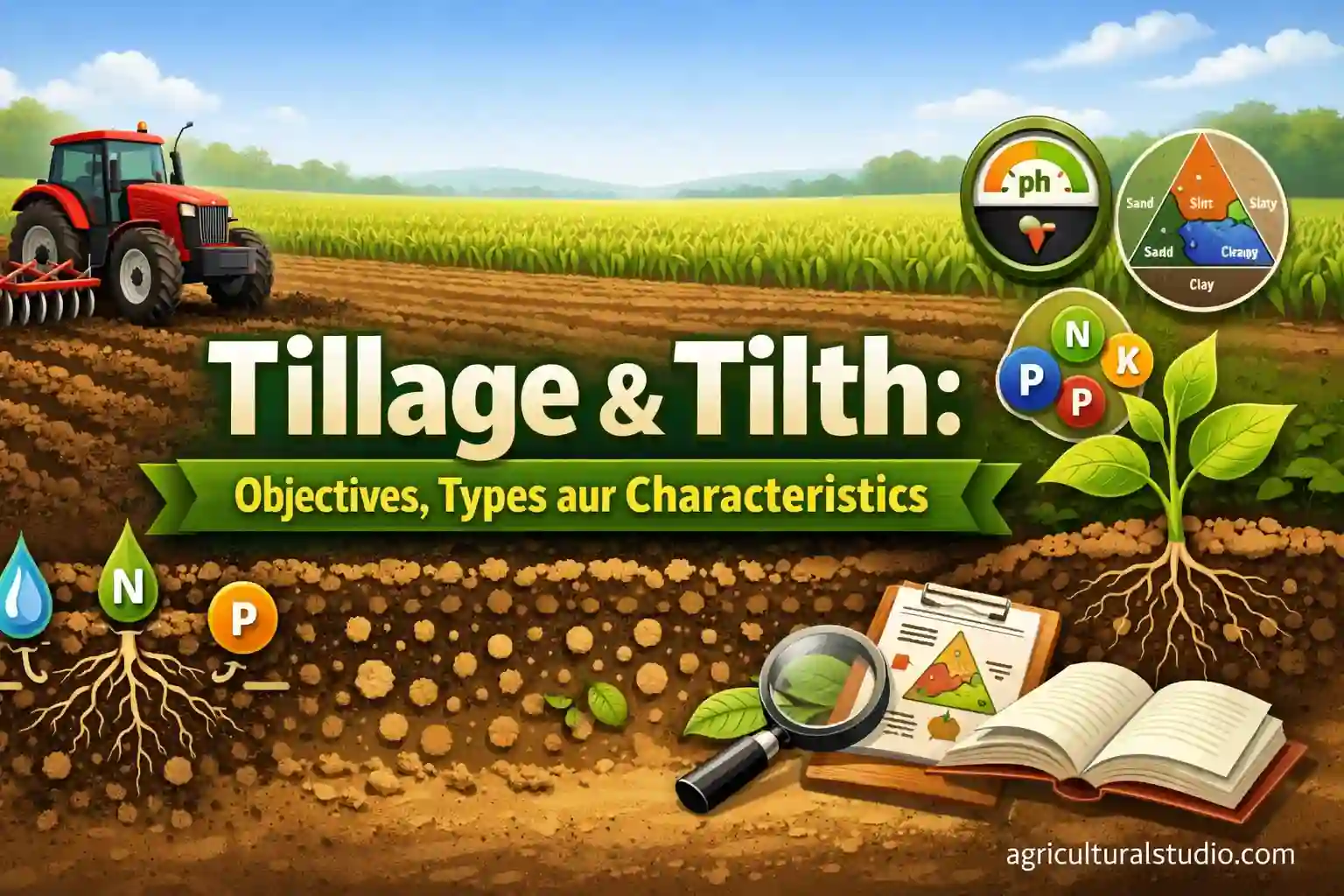
When we talk about crop production, the first and most important field operation that comes to mind is tillage and tilth. Before sowing any crop, farmers prepare the soil so that seeds can germinate easily and roots can grow without difficulty.
In simple words, tillage is the practice of preparing soil for growing crops. Every farmer in India, whether using a tractor or bullocks, performs some form of tillage before sowing. As an agriculture student, you will find this topic very important for BSc Agriculture exams, ICAR, State PSCs, and other competitive exams.
Let us understand tillage step by step, just like a teacher explaining in class.
This topic is part of our Agronomy Notes series for agriculture students.
Meaning of Tillage
Tillage means physical manipulation of soil using different tools and implements such as ploughs, harrows, or cultivators.
The word tillage comes from the Anglo-Saxon word “Tilian”, which means to cultivate.
👉 Father of Tillage: Jethro Tull
The main aims are:
- To make soil loose
- To prepare a good seedbed
- To help seeds germinate properly
- To support healthy root growth
What is Tilth?
Tilth is the result of tillage.
It describes the physical condition of soil after tillage operations.
Soil with good tilth is:
- Easy to work
- Well-aerated
- Able to hold water properly
- Suitable for seed germination
In simple terms, tillage is the process, tilth is the outcome.
Difference Between Tillage and Tilth
| Basis | Tillage | Tilth |
|---|---|---|
| Meaning | Tillage is the mechanical operation of soil using tools and implements | Tilth is the physical condition of soil after tillage |
| Nature | It is an action or process | It is a result or condition |
| Purpose | To prepare land for sowing, control weeds, and mix residues | To provide a favorable environment for seed germination and root growth |
| Involves | Ploughing, harrowing, hoeing, leveling etc. | Soil structure, porosity, moisture, and aeration |
| Depends on | Type of implement, depth, and method of cultivation | Quality of tillage, soil type, and organic matter |
| Timing | Done before or after sowing | Exists after tillage is completed |
| Can be seen as | “What we do to soil” | “Condition of soil we get |
| Example | Ploughing field with mould board plough | Loose, well-aerated, crumbly soil ideal for crops |
Simple Way to Remember (Exam Trick 🧠)
- Tillage = Action
- Tilth = Condition
👉 Good tillage leads to good tilth.
Characteristics of Good Tilth
1. Size Distribution of Soil Aggregates
Soil particles stick together to form small clods called aggregates.
The proportion of different sizes of these aggregates is called size distribution.
- Ideal aggregate size 1–5 mm (Different farming situations need different aggregate sizes)
- Irrigated areas aggregate more than 5 mm. it helps in better drainage and aeration
- Rainfed (dryland) areas aggregate 1–2 mm. It helps conserve moisture.
👉For example:
In dryland farming of Rajasthan, smaller aggregates help conserve moisture and In irrigated paddy fields of Punjab, larger aggregates are acceptable.
2. Mellowness or Friability of Soil
- Mellow soil means soil clods break easily into small crumbs.
- Soil is not hard or sticky.Such soil is easy to plough and good for root growth.
- Such soil is easy to plough and good for root growth.
3. Proper Soil Pore Balance
Micro pore(capillary)50 more water hold: Macro pore(Non-capillary)more air hold 50
A good tilth means a balance of both pores.
This balance is necessary for:
- Root respiration
- Water availability
- Microbial activity
Objectives of Tillage
Tillage is not done randomly. Every operation has a purpose. For example summer ploughing exposes soil insects to sunlight, killing them naturally.
Main objectives include:
- Preparation of a good seedbed.
- Control of weeds.
- Conservation of soil and water.
- Inversion of soil (bringing lower soil up).
- Destruction of insects and pests hiding in soil.
- Improvement of soil structure.
- Better soil permeability.
- Improved aeration and root penetration.
- Mixing of manures, fertilizers, pesticides, and soil amendments.
Types of Tillage
Broadly, tillage is classified into two types:
A. Preparatory Tillage (Before sowing)
B. After Cultivation (After sowing)
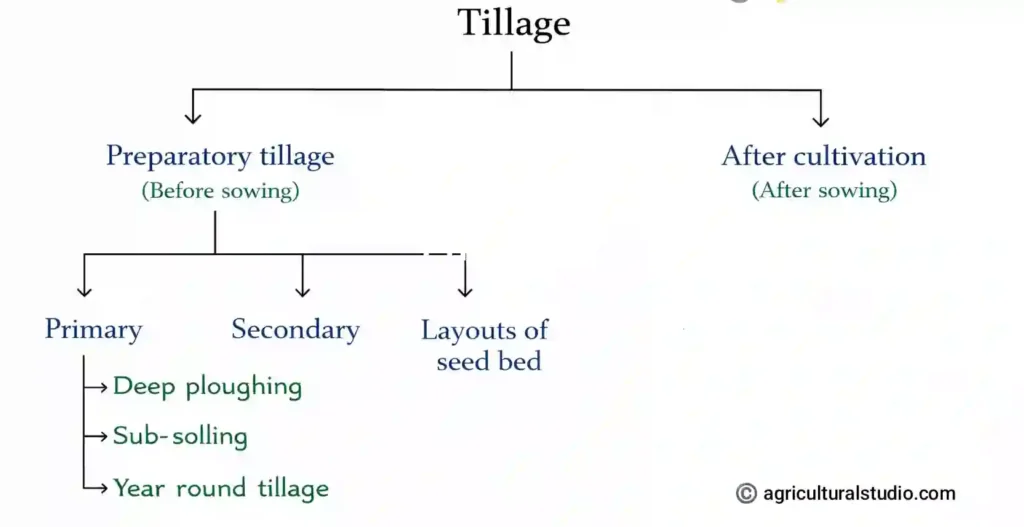
A. Preparatory Tillage
Preparatory tillage includes all soil operations done before sowing to prepare the seedbed.
Types of Preparatory Tillage
- Primary tillage
- Secondary tillage
- Layout of seedbed
1.Primary Tillage
Primary tillage is the first major soil operation.
Its main purpose is to:
- Open hard soil
- Break hard pan
- Invert soil
Important Points
- Best time of ploughing depends on soil moisture.
- Optimum soil moisture for ploughing: 25–50% DASM.
- (Depletion of Available Soil Moisture).
Number of Ploughings
- Heavy soil (clayey): 3–5 ploughings
- Light soil (sandy): 1–3 ploughings
Selection of Plough
Different ploughs are used based on purpose:
- MB plough (tractor-drawn) Deep ploughing and Good soil inversion.
- MB plough (animal-drawn) Mixing of manures and residues.
- Disc plough (Cuts deep-rooted weeds and grasses also useful in hard and dry soils).
- Country plough Common in traditional farming.
Types of Primary Tillage
1. Deep Ploughing
- Depth: 25–30 cm
- Done using MB plough or soil-turning plough.
- Mostly done in summer to break hard pan.
Depth Classification (CRIDA, Hyderabad)
- Shallow ploughing: 5–6 cm
- Medium ploughing: 15–20 cm
- Deep ploughing: 25–30 cm
2. Sub-soiling
- Depth: 60–70 cm
- Done using sub-soiler or chisel plough
- Breaks underground hard pan
- Improves water infiltration and root growth
3. Year-Round Tillage
Tillage operations done throughout the year, not limited to one season.
Implements Used in Primary Tillage
- Animal-Drawn: Indigenous plough, MB plough
- Tractor-Drawn: MB plough, Disc plough, Heavy-duty disc harrow, Sub-soiler, Chisel plough
2. Secondary Tillage
Secondary tillage includes lighter operations after the primary tillage.
Its main aim is to:
- Make soil finer
- Level the field
- Prepare soil for sowing
Secondary Tillage Implements
Harrow, Roller, Pulveriser, Rotary tiller
👉 Heavy disc harrow is not included here
Difference between Primary and Secondary Tillage
| Primary Tillage | Secondary Tillage |
|---|---|
| Deep operation | Shallow operation |
| Done first | Done after primary |
| Soil remains rough | Soil becomes fine & level |
3. Layout of Seedbed
After tillage, the field is Leveled, Divided into plots, Prepared for irrigation and sowing
This is very important in irrigated crops like rice and vegetables.
B.After Cultivation (After Sowing)
Tillage operations carried out after sowing in standing crops are called after cultivation.
Operations Include:Side dressing of fertilizers, Inter-cultivation and Earthing up.
For example: Earthing up in potato and sugarcane supports plants and controls weeds.
🛑Important Questions on Tillage and Tilth
What is tillage?
Tillage is the mechanical working of soil to prepare land for sowing and crop growth.
What is tilth?
Tilth is the physical condition of soil after tillage, which affects seed germination and root growth.
What is the main difference between tillage and tilth?
Tillage is an operation, while tilth is the result or condition of soil after tillage.
Why is primary tillage important?
Primary tillage helps in deep loosening of soil, weed control, and incorporation of crop residues.
Which tillage operation prepares a fine seedbed?
Secondary tillage prepares a fine, smooth, and level seedbed suitable for sowing.

Leave a Reply