

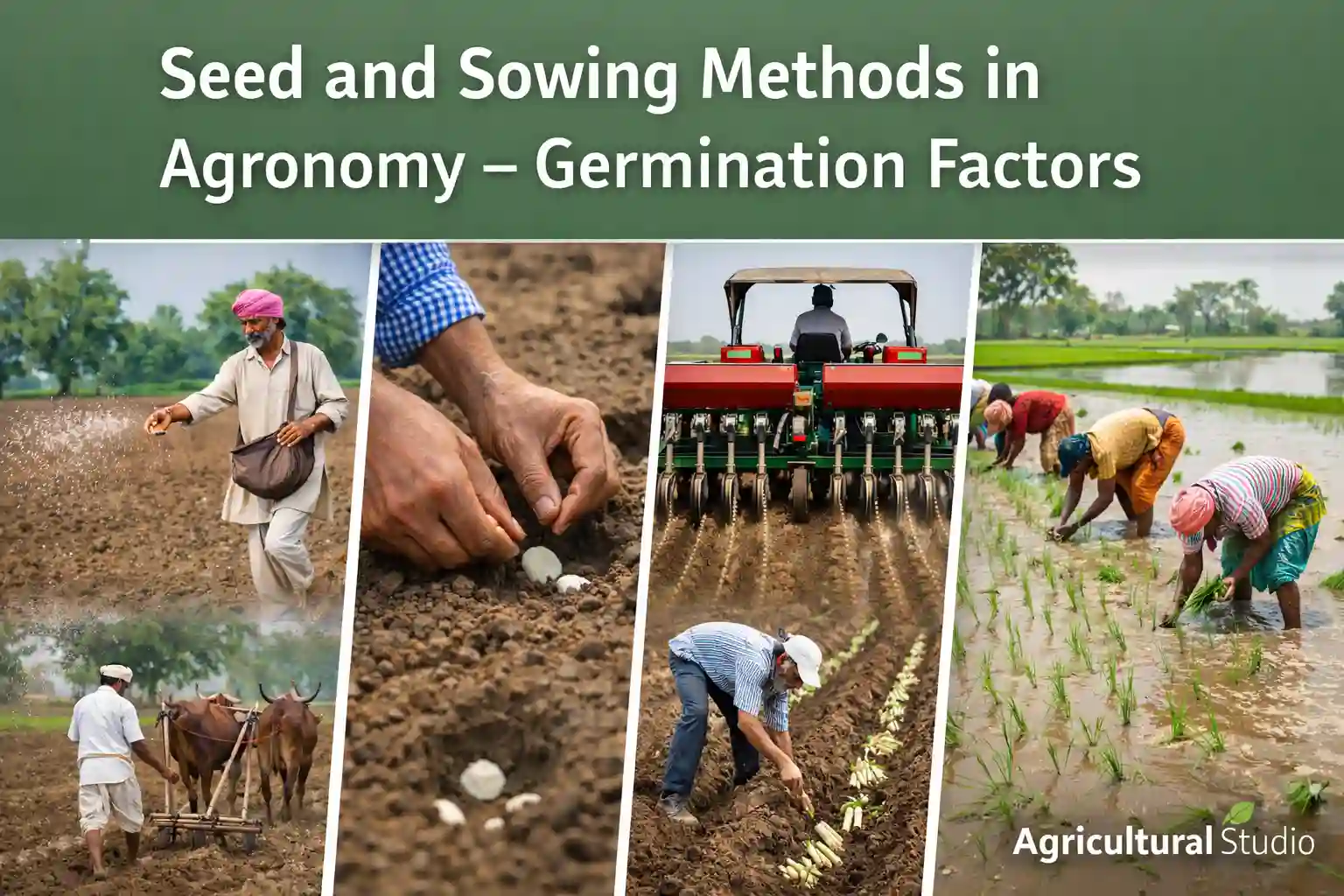
In agriculture, everything starts with a seed.
If the seed is good and sown properly, half of the crop success is already achieved. So that seed and sowing methods are an important concept in agronomy. Many crop failures happen not because of fertilizers or irrigation, but due to poor seed quality or wrong sowing method.
In this blog, we will clearly understand:
- What is a seed?
- What is seed material?
- Important factors needed for seed germination.
- Methods of sowing.
This explanation is written specially for BSc Agriculture students and competitive exams like ICAR, CUET, State PSC, etc.
This topic is part of our Agronomy Notes series for agriculture students.
What is a Seed?
A seed is any plant part used for propagation or multiplication of plants.
Most students think only fertilized ovule is seed, but that is not fully correct.
Plant materials that act as seed: Leaf, Stem, Root, Fertilized ovule (true seed)
👉 Example: Potato farmers use tubers
, Sugarcane farmers use stem cuttings (setts), Onion farmers use bulbs
So, seed does not always mean grain.
Seed Material
Seed material is classified based on how the plant reproduces.
There are two main types:
1. Seed Material from Sexual Reproduction
In sexual reproduction, a fertilized ovule develops into a seed.
Example: Wheat, Rice, Maize, Mustard
Important terms to remember:
- Seed: Fertilized ovule used for raising crops or multiplication.
- Grain: Fertilized ovule used for food or feed purpose.
2. Seed Material from Asexual Reproduction
Here, new plants are produced without fertilization.
This method is very common in horticultural and plantation crops in India.
A. Natural Methods of Asexual Reproduction
These occur naturally without human help.
| Plant parts | Example |
|---|---|
| Stem | Sugarcane (setts) |
| Rooted slips | Napier grass |
| Tuber | Potato |
| Bulb | Onion, Garlic |
B. Artificial Methods of Asexual Reproduction
These are done with human intervention.
| Methods | Example |
|---|---|
| Layering | Litchi |
| Budding | Ber |
| Grafting | Mango |
| Tissue culture | Banana |
📌 Tissue culture banana is widely used in India for uniform plants and higher yield.
Essential Factors for Seed Germination
Seed germination does not happen automatically just by putting seed into the soil. For successful germination, some basic conditions must be available. If even one factor is missing, the seed may fail to germinate or produce weak seedlings.
A seed will germinate only when these conditions are fulfilled:
1. Capacity of the Seed to Germinate
First of all, the seed itself must be alive and healthy.
Only viable seeds can germinate. Old, damaged, or diseased seeds usually fail to sprout.
2. Moisture
Water is essential for germination.
Moisture helps the seed absorb water, which activates enzymes and starts growth of the embryo.
✓Too little water → seed remains dormant
✓Too much water → seed may rot due to lack of oxygen
👉 This is why proper irrigation after sowing is important.
3. Temperature
Every crop requires a suitable temperature range for germination.
Very low or very high temperature can delay or stop germination.
👉 Examples:
✓ Wheat germinates well in cool conditions.
✓ Rice requires comparatively warm temperature.
This is the reason crops are sown in specific seasons.
4. Oxygen Supply
Seeds need oxygen for respiration during germination. If soil becomes waterlogged or compacted, oxygen supply reduces and germination suffers.
👉 Well-aerated soil always supports better seed germination.
Method of Sowing
Sowing means placing seed or plant material into the soil.
There are two basic terms you must clearly understand.
- Seed Sowing: Placing seed into the soil for germination
- Planting: Placing plant propagules into the soil
Plant propagules include Seedlings, Roots, Tubers, Leaves, Cuttings.
👉 Example:
Wheat → Seed sowing
Sugarcane → Planting
Different Methods of Sowing
Sowing method means how seeds are placed in the soil. Choosing the correct sowing method helps in proper spacing, uniform germination, and good crop stand.
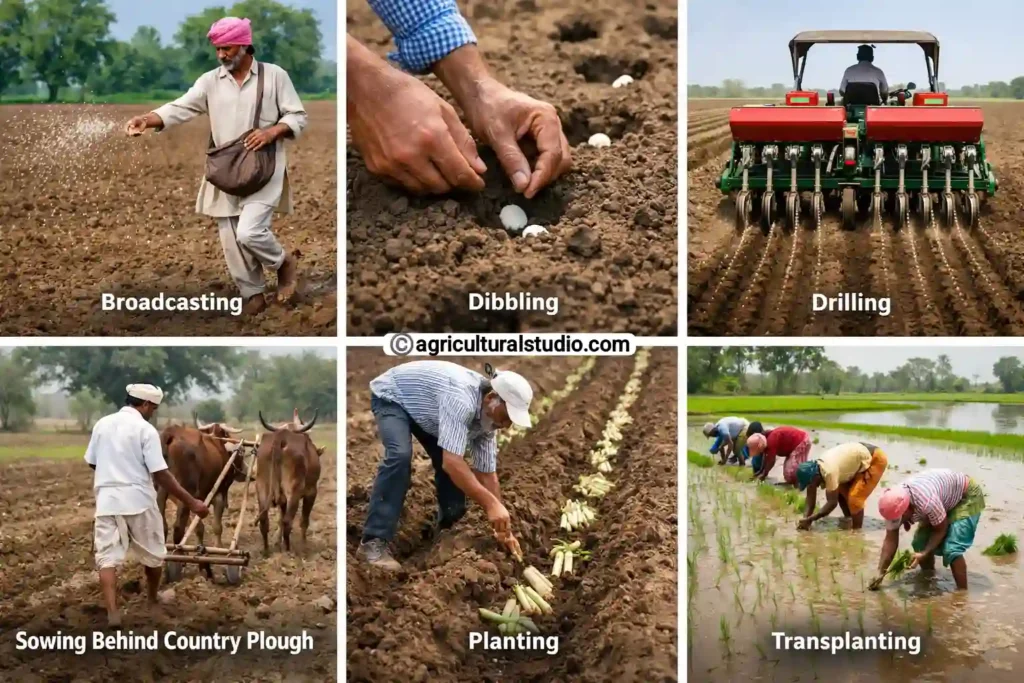
Different sowing methods used in Indian agriculture are explained below:
1. Broadcasting
Broadcasting is the oldest and simplest method of sowing.
- Seeds are scattered on the soil surface.
- Done manually or with mechanical spreaders.
👉 Commonly used for: Wheat, Rice (direct seeding), Fodder crops
Although this method is easy, seed distribution is often uneven.
2. Dibbling
In dibbling, seeds are placed in small holes or pits at fixed depth and spacing.
- Ensures equal distance between plants
- Done using dibbler, planter, or by hand
👉 Common crops: Maize, Cotton, Pigeon pea
This method is suitable for crops with bold seeds.
3. Drilling
In drilling, seeds are dropped continuously in furrows and then covered with soil.
- Maintains proper depth and spacing
- Can be done manually or with seed drill
👉 Common crops: Wheat, Barley, Mustard
This method gives uniform germination and better plant population.
4. Sowing Behind Country Plough
This is a traditional sowing method used mainly in rural areas.
- Seeds are dropped behind the plough by a person.
- Simple and low-cost method.
Types:
1. Kera method
2. Pora method
👉 Mostly used in rainfed farming systems.
5. Planting
Planting refers to placing plant parts or propagules firmly into the soil for growth.
👉 Examples:
Sugarcane setts
Potato tubers
Banana suckers
This method ensures strong establishment of crops.
6. Transplanting
Transplanting is the method of shifting seedlings from nursery to the main field.
- Seedlings are first raised in nursery
- Later planted in prepared field
👉 Common crops: Rice, Vegetables, Tobacco
This method helps in better field management and healthy crop growth.
Important Questions ❓
What is seed in agronomy?
Seed is any plant part used for raising a new crop. It may be a fertilized ovule (true seed) or vegetative part like stem, root, tuber, or bulb.
What is sowing?
Sowing is the process of placing seeds or planting materials into the soil for germination and growth of a crop.
What are the essential factors required for seed germination?
The main factors required for seed germination are:
✓Viable seed (capacity to germinate)
✓Moisture
✓Suitable temperature
✓Oxygen supplyWithout these conditions, germination will be poor or may not occur.
Why is moisture important for seed germination?
Moisture helps the seed absorb water, activates enzymes, and starts the growth of the embryo. Too little water prevents germination, while too much water can cause rotting.
What is the role of temperature in germination?
Each crop has an optimum temperature for germination. Low temperature slows germination, and very high temperature may damage the seed.
Which sowing method is best for wheat?
Drilling is the best sowing method for wheat because it maintains proper depth, spacing, and seed rate.
Which crops are usually transplanted?
Rice, vegetables, and tobacco are commonly transplanted crops.
What is dibbling method?
In dibbling, seeds are placed in holes or pits at fixed depth and spacing
What is drilling method?
Drilling is the method of sowing in which seeds are dropped continuously in furrows and then covered with soil.
Leave a Reply