

Manures in agriculture is an organic material used to improve soil fertility and support plant growth. It supplies essential nutrients to crops in a natural and gradual way.
Manures are usually bulky, do not have a fixed nutrient composition, and are mainly prepared from plant residues, animal waste, and biodegradable household waste.
Unlike chemical fertilizers, manures also improve soil structure and long-term soil health.
This topic is part of our Agronomy Notes series for agriculture students.
Classification of Manures in agriculture
Manures are broadly divided into two main groups:
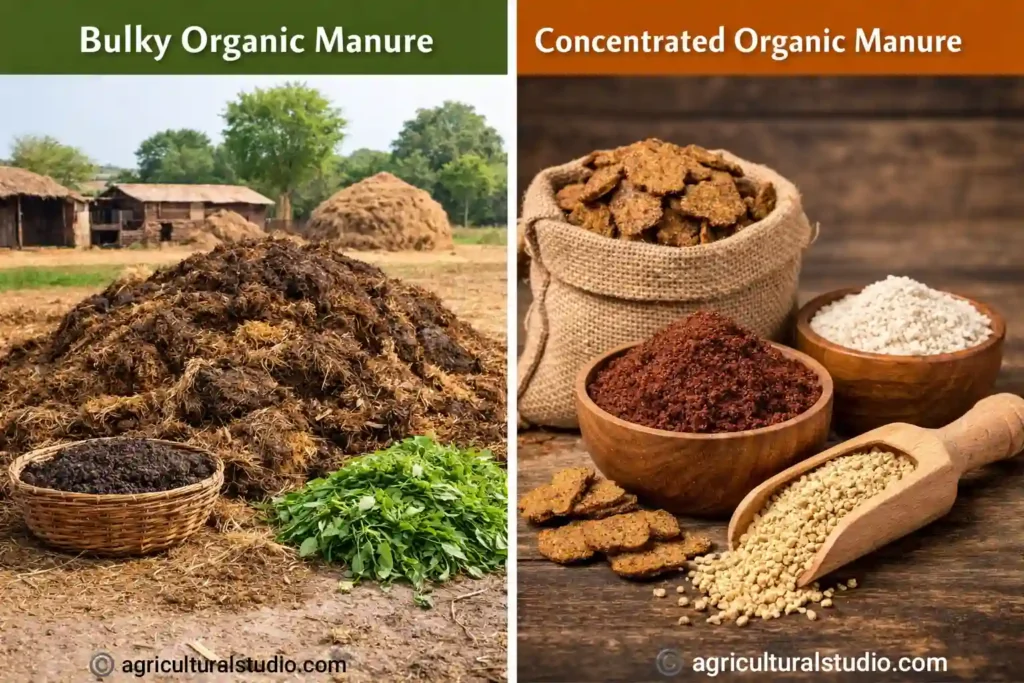
1. Bulky Organic Manures
(Slow acting and rich in organic matter)
These manures are applied in large quantities and mainly improve soil condition.
Examples: Farmyard manure (FYM), Compost, Green manure, Waste from human settlements (after proper treatment)
Main features:
- Low nutrient concentration
- Improve soil texture and water-holding capacity
- Supply nutrients slowly over time
2. Concentrated Organic Manures
(Quick acting and low in organic matter)
These manures contain higher nutrients and are applied in smaller amounts.
(a) Plant-based concentrated manures
Oil cakes (neem cake, groundnut cake, mustard cake, mahua cake)
(b) Animal-based concentrated manures
Blood meal, Bone meal, Fish meal
Main features:
- High nitrogen content
- Act faster than bulky manures
- Used as nutrient supplements
Importance of Manures in Soil Fertility Management
A. Role of Bulky Organic Manures
Bulky manures mainly improve soil quality in three ways:
1. Physical benefits
- Improve soil structure and aggregation
- Increase water-holding capacity in sandy soils
- Improve aeration and drainage in clay soils
- Reduce soil hardness and crust formation
2. Chemical benefits
- Increase organic carbon in soil
- Help in better nutrient retention
- Reduce nutrient losses due to leaching
- Slowly release nutrients like nitrogen, phosphorus, and potassium
3. Biological benefits
- Provide food for soil microorganisms
- Increase microbial population and activity
- Help convert unavailable nutrients into available forms
- Improve root growth due to better soil environment
B. Role of Concentrated Organic Manures
Concentrated manures have a more direct impact on crop growth.
Key points:
- They contain higher nitrogen than bulky manures.
- Nitrogen content varies:
- About 2.5% in mahua cake
- Up to 7.9% in decorticated safflower cake.
- Apart from nitrogen, oil cakes also supply:
- Phosphorus (P₂O₅): around 0.8%
- They act faster because nutrients are present in a more available form.
- Suitable for crops needing quick nutrient supply.
Difference Between Bulky and Concentrated Manures
| Feature | Bulky Manures | Concentrated Manures |
|---|---|---|
| Quantity used | Large | Small |
| Organic matter | High | Low |
| Nutrient content | Low | High |
| Speed of action | Slow | Fast |
| Main purpose | Improve soil health | Supply nutrients |
Nutrient composition of Common Manures
| Manure | N (%) | P₂O₅ (%) | K₂O (%) |
|---|---|---|---|
| Castor cake | 4.3 | 1.8 | 1.3 |
| Groundnut cake | 7.3 | 1.5 | 1.3 |
| FYM | 0.5 | 0.25 | 0.5 |
| Farm compost | 0.5 | 0.15 | 0.5 |
| Town compost | 1.4 | 1.0 | 1.4 |
| Night soil | 5.5 | 4.0 | 2.0 |
| Vermicompost | 3.0 | 1.0 | 1.5 |
| Sheep & goat manure | 3.0 | 1.0 | — |
| Poultry manure | 3.03 | 2.63 | 1.4 |
| Safflower cake | 7.9 | 2.2 | 1.9 |
Conclusion
Manures play a major role in sustainable agriculture. They improve soil structure, increase nutrient availability, and support soil life. Bulky manures mainly improve soil health, while concentrated manures supply nutrients faster. Using manures properly helps Indian farmers reduce chemical fertilizer use and maintain long-term soil fertility.

Leave a Reply