

If you are studying BSc Agriculture or preparing for competitive exams like ICAR, JRF, or state agriculture exams, Plant Propagation is a very important topic. Questions are often direct and factual. In fact, Plant Propagation in Horticulture is one of the most scoring areas in fruit science and nursery management.
Let us understand it in a very simple way.
What is Plant Propagation?
Plant propagation simply means multiplication of plants.
In easy words, it is the process of producing new plants from existing plants.
For example:
- When a farmer sows wheat seeds in his field → that is propagation.
- When a nursery prepares mango plants by grafting → that is also propagation.
So basically, we increase plant population either by seeds or by plant parts.
In practical farming and nursery work, this process is known as Plant Propagation in Horticulture, especially when we deal with fruit, vegetable, and ornamental crops.
Classification of Plant Propagation
Plant propagation is divided into two main types:
- Sexual Propagation
- Asexual (Vegetative) Propagation
Both methods are widely used in Plant Propagation in Horticulture, depending on crop and purpose.
Let us understand both one by one.
(A) Sexual Propagation
What is Sexual Propagation
Sexual propagation means multiplication of plants through seeds.
When pollination and fertilization take place, seeds are formed. These seeds grow into new plants.
Example: Wheat, Paddy, Mustard, Many forest trees
Special Terms in Sexual Propagation
1. Polyembryony
When more than one embryo develops inside a single seed, it is called polyembryony.
Example: Citrus (like orange and lemon)
2. Vivipary
When seeds start germinating while still attached to the parent plant.
Example: Mangroves
Advantages of Sexual Propagation
- Plants are long-lived
- Strong root system
- More resistant to diseases
- Seeds are easy to store and transport
- Helps in developing new varieties
- Creates genetic diversity (important in plant breeding)
Disadvantages of Sexual Propagation
- Chances of seed-borne diseases
- Plants take longer time to bear fruits
- Variation occurs (not true to type)
That is why seed propagation is limited in commercial fruit production under Plant Propagation in Horticulture.
(B) Asexual (Vegetative) Propagation
In this method, new plants are produced from vegetative parts like stem, root, or leaf.
No seed is involved.
Two types:
- [I] In vivo – done in field or nursery
- [II] In vitro – done in laboratory (tissue culture)
What is In–Vivo Methods (Field Methods)
Main methods:
- Cutting
- Budding
- Grafting
- Layering
Let us study each clearly.
1. Cutting
Cutting means using a part of a plant and planting it to produce a new plant.
(i) Stem Cutting
A part of stem is used.
Types of Stem Cutting
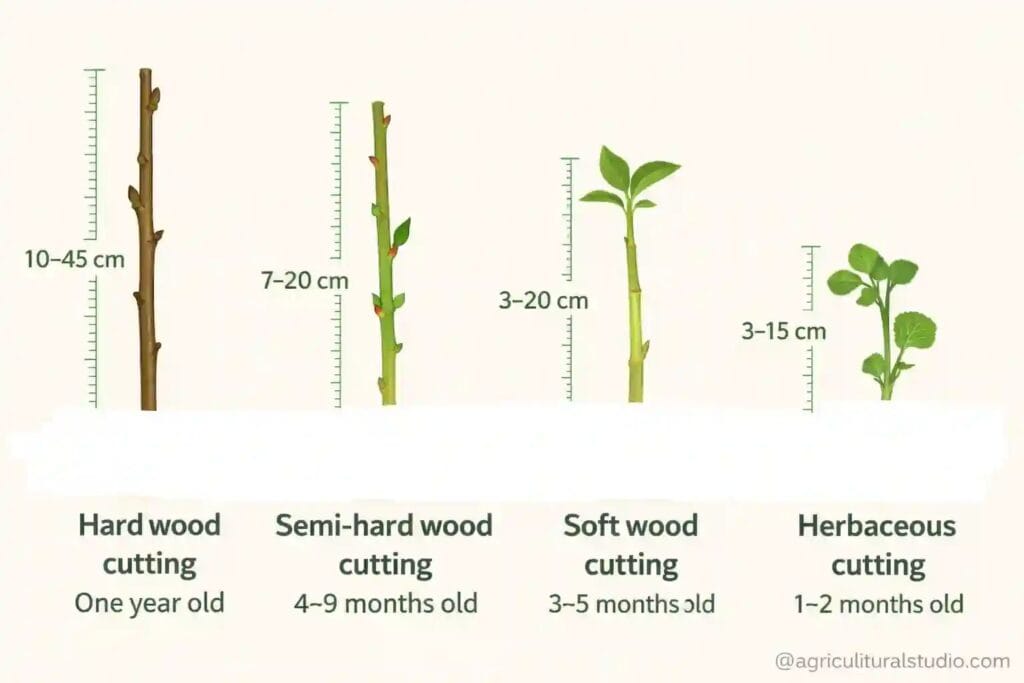
1. Hard Wood Cutting
- One-year-old mature shoot
- Length: 10–45 cm
- At least 2–3 buds
- Taken during November–December
Examples: Grape, Pomegranate, Mulberry, Rose, Fig
2. Semi-Hard Wood Cutting
- 4–9 months old shoots
- Length: 7–20 cm
- 2–4 leaves kept
- Pencil thickness
- IBA treatment: 5000 ppm for better root formation
Examples: Mango, Guava, Aonla, Lemon, Jackfruit
3. Soft Wood Cutting
- 3–5 months old shoots
- 3–20 cm length
- 2–4 buds
- Mostly used in ornamental plants
Example: Tea
4. Herbaceous Cutting
- 1–2 months old shoots
- Mostly ornamental plants
Examples: Coleus, Alternanthera, Pilea
Suitable Temperature for Cuttings
- Day: 21–27°C
- Night: 15°C
(ii) Root Cutting
Root pieces are used.
Root pieces of about 40 cm are planted.
Example: Sweet potato
(iii) Leaf Cutting
- Leaf is used for propagation.
- Mostly ornamental plants.
2. Budding
Budding means joining a single bud (scion) to a rootstock.
After union, they grow as one plant.
Budding is widely practiced in Plant Propagation in Horticulture for fruit crops.
Important Terms
- Scion – Bud used for propagation
- Rootstock – Plant on which bud is attached
- Union point – Place where both join
Methods of Budding
(i) Shield Budding / T-Budding
- Rootstock: 1 year old
- Done 20–30 cm above ground
- Bud length: 2.5–3 cm
Examples: Rose, Apple, Pear, Peach, Apricot
(ii) Patch Budding
- Square-shaped bark patch
- Used in thick bark plants
Examples: Mango, Aonla, Jamun, Bael, Cashew
(iii) Forkert Budding
Used in: Rubber
(iv) Ring Budding
Examples: Ber, Peach, Mulberry
(v) Chip Budding
Also important for temperate fruits.
3. Grafting
Grafting means joining a scion stick (with more than one bud) to a rootstock.
They unite and grow as a single plant. It is one of the most important techniques under Plant Propagation in Horticulture, especially for mango, guava, apple, and sapota.
Types of Grafting
(i) Epicotyl / Stone Grafting
- Seedling: 15–20 days old
- Scion: 2 months old
- Leaves removed 10 days before grafting
- Time: June–July
Examples: Mango, Cashew
👉Used for rapid multiplication.
👉In many Indian mango nurseries, stone grafting is very common.
(ii) Veneer Grafting
- Rootstock: 1 year old
- Scion: 10–15 cm, pencil thickness
- Time: May–September
Common in North India for mango.
(iii) Inarching / Approach Grafting
Scion remains attached to the mother plant until the union completes.
Examples: Sapota, Mango (South India)
(iv) Wedge Grafting
Used in:Guava
When grafting is done on top in wedge shape.
(v) Tongue Grafting
Modification of whip grafting.
Examples: Apple, Pear, Walnut
(vi) Whip Grafting
One-year-old rootstock
Examples: Apple, Pear, Walnut
(vii) Double Grafting
Used when scion and rootstock are not compatible.
An interstock is placed between them.
(viii) Bridge Grafting
Used to repair damaged trees (not for multiplication).
4. Layering
Layering means inducing roots on a shoot while it is still attached to the mother plant.
After roots form, it is separated.
Types of Layering
(i) Simple Layering
One-year-old shoot
Examples: Guava, Hazelnut
(ii) Serpentine Layering
Used in: Grape
Branch is buried at nodes, some parts remain exposed.
(iii) Mound Layering (Stooling)
Example: Guava
(iv) Tip Layering
Examples: Blackberry, Raspberry
(v) Air Layering
Indian name: Gootee
Chinese name: Marcottage
- One-year-old pencil-thick shoot
- Girdling: 2.5–3 cm
- Done in July–August
- IBA: 3000–5000 ppm
Examples: Litchi, Guava, Lime, Jackfruit, Cashew
In Bihar and West Bengal, litchi is commonly propagated through air layering.
(vi) Trench Layering
Examples: Apple, Pear, Cherry
Base is covered with 5–10 cm soil.
A detailed comparison of these methods is explained in our article on Difference Between Cutting, Budding, Grafting and Layering.
Natural Vegetative Propagation
Some plants propagate naturally
- Runner: Strawberry
- Sucker: Date palm, Pineapple
- Stolon: Mint, Bermuda grass
- Bulb – Onion, Garlic
- Corm – Gladiolus
- Rhizome – Ginger, Turmeric
- Tuber – Potato
What is In–Vitro Propagation (Tissue Culture)
- It is the modern method of Plant Propagation in Horticulture for rapid and disease-free multiplication
- Also called Micropropagation.
- Done in laboratory.
- Export-quality planting material
Example: Banana tissue culture plants are widely used in India for uniform yield.
Final Conclusion
Plant propagation is the backbone of agriculture and horticulture.
- If we want new varieties → Sexual propagation
- If we want true-to-type plants → Asexual propagation
- For large-scale, disease-free plants → Tissue culture
Understanding the practical applications of Plant Propagation in Horticulture makes this topic easy and highly scoring for exams.

Leave a Reply