

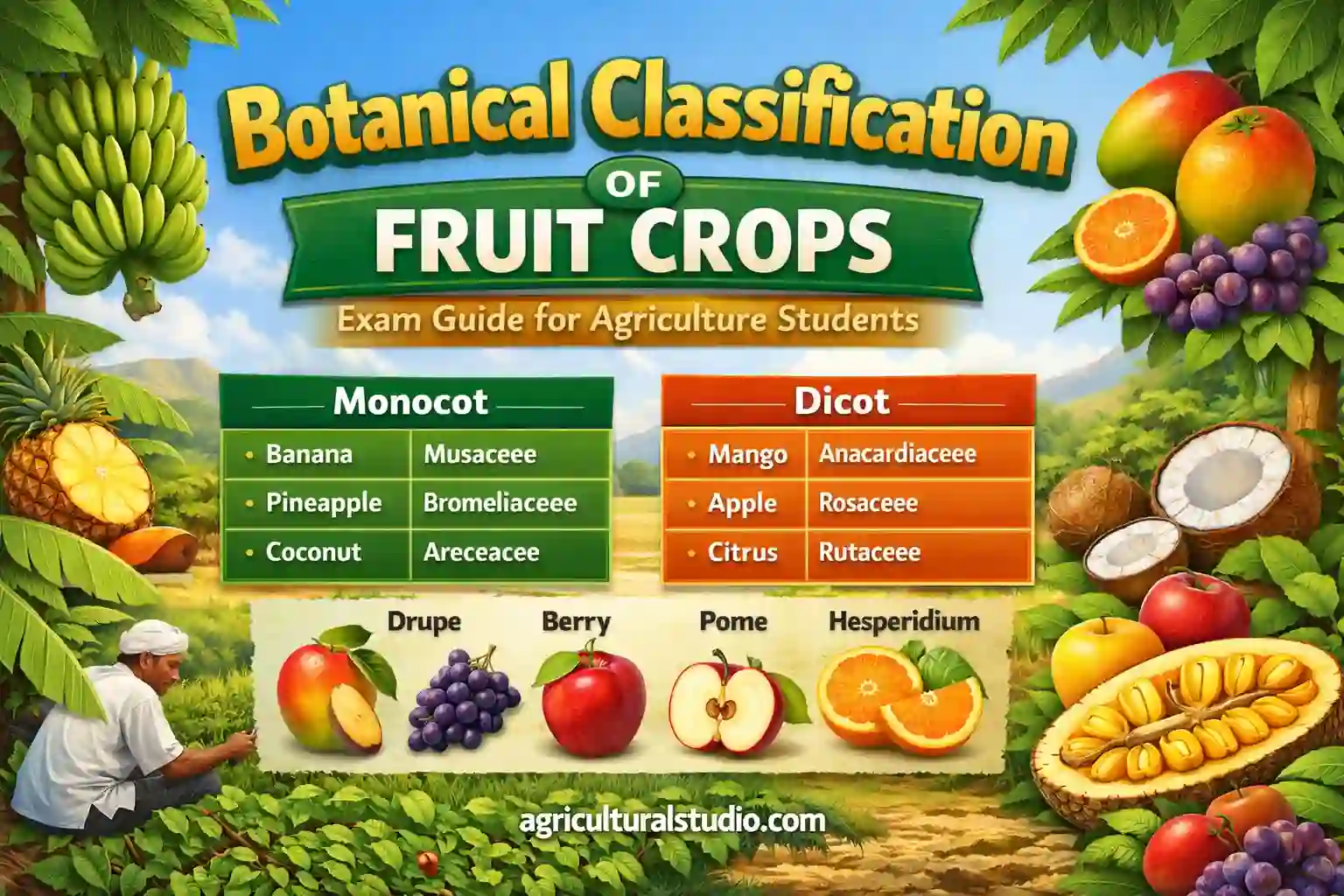
When we study fruit crops in horticulture, one important topic is Botanical classification of fruit crops. Many students find this topic boring because it looks like a long table of families and scientific names.
But if you understand it in a simple way, it becomes very easy and very scoring in exams.
In this article, I will explain botanical classification step-by-step in simple language, with Indian examples that you already know.
This topic is part of our Horticulture Notes series for agriculture students
What is Botanical classification of fruit crops?
Fruit Crops Classification means grouping plants based on their botanical characters like:
- Number of seed leaves (cotyledons)
- Flower structure
- Fruit type
- Plant family
In Botanical classification of fruit crops, plants are mainly divided into:
- Monocots
- Dicots
Let us understand both clearly.
1. Botanical Classification of Monocot Fruit Crops
| Family | Common Name | Scientific Name | Chromosome No. (2n) | Origin | Fruit Type |
|---|---|---|---|---|---|
| Musaceae | Banana | Musa paradisiaca | 22, 33, 44 | Indo-Burma | Berry |
| Bromeliaceae | Pineapple | Ananas comosus | 50, 75, 100 | Brazil | Aggregate berries |
| Arecaceae | Date palm | Phoenix dactylifera | 36 | West Asia | Drupe |
| Arecaceae | Coconut | Cocos nucifera | — | — | Drupe (fibrous) |
2. Botanical Classification of Dicot Fruit Crops
| Family | Common Name | Scientific Name | 2n | Origin | Fruit Type |
|---|---|---|---|---|---|
| Anacardiaceae | Mango | Mangifera indica | 40 | S.E. Asia | Drupe |
| Cashewnut | Anacardium occidentale | 42 | Brazil | Nut | |
| Annonaceae | Custard apple | Annona squamosa | 14 | Bolivia | Aggregate berries |
| Caricaceae | Papaya | Carica papaya | 18 | Tropical America | Berry |
| Euphorbiaceae | Aonla | Emblica officinalis | 28 | S.E. Asia | Capsule (drupe-like) |
| Moraceae | Jackfruit | Artocarpus heterophyllus | 56 | India | Sorosis |
| Monkey jack | Artocarpus lakoocha | 56 | Western Ghats | Sorosis | |
| Fig | Ficus carica | 26 | — | Syconus | |
| Mulberry | Morus alba | 308 | — | Sorosis | |
| Myrtaceae | Guava | Psidium guajava | 22 | Tropical America | Berry |
| Jamun | Syzygium cumini | 40 | India | Drupe | |
| Rosaceae | Apple | Malus domestica | 34 | S.W. Asia | Pome |
| Pear | Pyrus communis | 34 | Western China | Pome | |
| Peach | Prunus persica | 16 | China | Drupe | |
| Plum | Prunus domestica | 32 | China | Drupe | |
| Apricot | Prunus armeniaca | 16 | N.E. China | Drupe | |
| Almond | Prunus amygdalus | 16 | Central Asia | Drupe | |
| Strawberry | Fragaria ananassa | 56 | France | Etaerio of achenes | |
| Loquat | Eriobotrya japonica | 34 | China | Pome | |
| Rutaceae | Mandarin | Citrus reticulata | 18 | S.E. Asia | Hesperidium |
| Sweet orange | Citrus sinensis | 18 | Indo-China | Hesperidium | |
| Lemon | Citrus limon | 18 | S.E. Asia | Hesperidium | |
| Acid lime | Citrus aurantifolia | 18 | Iran | Hesperidium | |
| Grapefruit | Citrus paradisi | 18 | West Indies | Hesperidium | |
| Bael | Aegle marmelos | 18 | India | Amphisarca | |
| Wood apple | Feronia limonia | 18 | India | Amphisarca | |
| Vitaceae | Grape | Vitis vinifera | 38 | S.E. Asia & Europe | Berry |
| Sapindaceae | Litchi | Litchi chinensis | 30 | South China | — |
| Sapotaceae | Sapota | Achras zapota | 26 | South America | Berry |
| Juglandaceae | Walnut | Juglans regia | 32 | Central Asia | Nut |
| Pecan nut | Carya illinoensis | 32 | North America | Nut |
Botanical classification is one of the important bases of fruit crop classification.
👉 To understand other types, read: Classification of Fruit Crops
🔎Important Botanical Classification of Fruit Crops (Quick Revision Section)
Students often confuse Fruit Crops Classification. So let us revise simply:
- Drupe → Mango, Peach, Plum, Coconut
- Berry → Banana, Guava, Papaya, Grape
- Pome → Apple, Pear
- Hesperidium → Citrus fruits
- Sorosis → Jackfruit, Mulberry
- Syconus → Fig
- Nut → Cashew, Walnut
- Aggregate berries → Custard apple
- Etaerio of achenes → Strawberry
How to Remember Families Easily?
Instead of mugging up the table, follow this method
- Group citrus fruits together → Rutaceae
- Group temperate fruits together → Rosaceae
- Remember tropical commercial fruits separately:
- Mango → Anacardiaceae
- Banana → Musaceae
- Papaya → Caricaceae
- Guava → Myrtaceae
Final Conclusion
Botanical Classification of Fruit Crops may look like a long list, but it becomes simple when you understand patterns.
Remember these key ideas:
- First divide into monocots and dicots.
- Then focus on important families.
- Pay special attention to fruit types.
- Connect crops with Indian growing regions.
Do not try to memorize everything in one day.
Revise small groups daily.
If you understand the logic behind classification, you will never forget it — and you will score easily in exams.
Keep learning. Keep revising. 🌱


Leave a Reply