

Fruit crops are not grouped randomly. The classification of fruit crops in Horticulture is done based on climate, ripening behavior, flowering pattern, pollination system, edible part, and many other features.
For BSc Agriculture and competitive exams like ICAR, JRF, SRF, NABARD, and State Agriculture exams, this topic is very important. Many direct one-line questions are asked from here.
In this blog, we will understand everything in a simple and practical way with Indian examples.
This topic is part of our Horticulture Notes series for agriculture students
Table of Contents
Classification of fruit crops in Horticulture
1. Classification Based on Climate
Climate is the first and most basic way to classify fruit crops. Every fruit has a specific temperature and rainfall requirement.
A. Tropical Fruits
These fruits grow well in hot and humid climates.
- Need high rainfall
- Prefer high humidity
- Optimum temperature: 22–27°C
- Sensitive to frost
Examples: Mango, Banana, Papaya, Sapota, Guava, Pineapple, Jackfruit, Cashew, Coconut, Mangosteen
In states like Maharashtra, Andhra Pradesh, Karnataka, Kerala, and Tamil Nadu, tropical fruits dominate. Alphonso mango from Ratnagiri is a classic tropical fruit example.
B. Temperate Fruits
These fruits need cool climate and chilling temperature during winter.
- Grow in cold regions
- Require chilling hours
- Cannot tolerate extreme heat
Examples: Apple, Pear, Peach, Plum, Strawberry, Walnut, Almond, Cherry, Kiwi
You will find these in Himachal Pradesh, Jammu & Kashmir, Uttarakhand.
C. Subtropical Fruits
Subtropical fruits grow in moderate climate. They tolerate mild winter and hot summer.
Subtropical fruits are further divided into:
✓Subtropical
✓Arid & Semi-arid
(i) Subtropical Fruits
These fruits can tolerate mild cold but not severe frost.
Examples: Litchi, Pomegranate, Karonda, Date palm, Bael, Grape, Mandarin, Citrus, Jamun, Aonla, Fig, Loquat
Litchi from Bihar, Nagpur mandarin from Maharashtra, and Aonla from UP are good examples.
(ii) Arid & Semi-Arid Fruits
These fruits tolerate drought and low rainfall.
Examples: Ber, Aonla, Annona, Pomegranate, Date palm, Bael, Phalsa, Jamun
- Ber and pomegranate are widely grown in Rajasthan and dry parts of Maharashtra.
- Aonla and Pomegranate often appear in both subtropical and arid lists.
2. Based on Ripening Behaviour
This is a very important classification for exams.
(i) Climacteric Fruits
These fruits show a sudden rise in respiration during ripening.
They can ripen even after harvesting.
Examples: Mango, Banana, Apple, Guava, Papaya, Jackfruit, Plum, Apricot, Kiwi, Annona, Tomato
If you buy raw mangoes and keep them at home, they ripen. That is because mango is climacteric.
(ii) Non-Climacteric Fruits
These fruits do not show sudden respiration rise.
They must ripen on the plant.
Examples: Litchi, Lemon, Orange, Grape, Pomegranate, Pineapple, Watermelon, Strawberry, Cherry, Jamun
If you pluck raw grapes, they will not ripen properly at home.
3. Based on Growth Pattern (Sigmoid Curve)
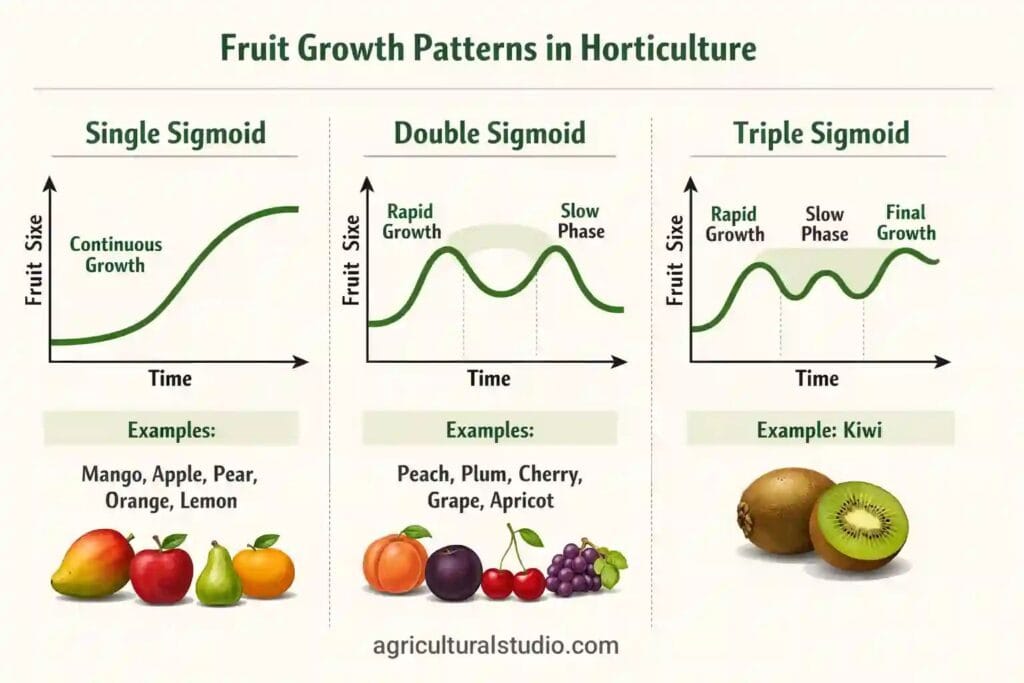
Fruit growth follows a sigmoid curve.
(i) Single Sigmoid
One continuous growth phase.
Examples: Mango, Apple, Date palm, Pear, Sweet orange, Lemon
(ii) Double Sigmoid
Two rapid growth phases separated by a slow phase.
Examples: Peach, Plum, Cherry, Apricot, Grape, Fig, Olive, Sapota, Pineapple
(iii) Triple Sigmoid
Three growth phases.
Example: Kiwi
4. Based on Photoperiod (Day Length Requirement)
Some fruits are affected by day length during flowering.
(i) Short Day Plants
Need 12 hours or less light.
Examples: Strawberry, Pineapple, Coffee
(ii) Long Day Plants
Need 14 hours or more light.
Examples: Apple, Passion fruit
Note: Apple flowering is also influenced by chilling (vernalization).
(iii) Day Neutral Plants
No effect of day length.
Examples: Papaya, Guava, Banana
👉 Most tropical fruits are day neutral.
5. Based on Dichogamy (Maturity of Sex Organs)
Dichogamy means male and female parts mature at different times.
(i) Protandry
Male matures first.
Examples: Coconut, Sapota, Walnut, Annona, Passion fruit
(ii) Protogyny
Female matures first.
Examples: Banana, Fig, Pomegranate, Plum, Annona
To understand Dichogamy in detail, read our complete notes on Pollination in Plants: Definition, Types and Mechanisms Promoting Self and Cross Pollination
6. Based on Edible Portion
Very important for one-mark questions.
| Fruit | Edible Part |
|---|---|
| Mango | Mesocarp |
| Banana | Mesocarp + Endocarp |
| Coconut | Endosperm |
| Apple | Thalamus |
| Guava | Thalamus + Pericarp |
| Litchi | Aril |
| Pomegranate | Juicy seed covering |
| Almond | Seed |
| Citrus | Juicy placental hairs |
👉 Remember: Apple is a false fruit (thalamus is edible).
7. Acids Present in Fruits
Acids give sour taste.
- Citric Acid: Citrus fruits, Guava, Pineapple, Tomato
- Malic Acid: Apple, Banana, Plum, Pear
- Tartaric Acid: Tamarind, Grape
8. Alternate Bearing
Alternate bearing means heavy crop one year, very light crop next year.
Examples: Mango, Apple, Olive, Persimmon, Pecan nut, Date palm
In mango orchards, farmers often say: “Is saal bahut phal hai, agle saal kam hoga.” That is alternate bearing.
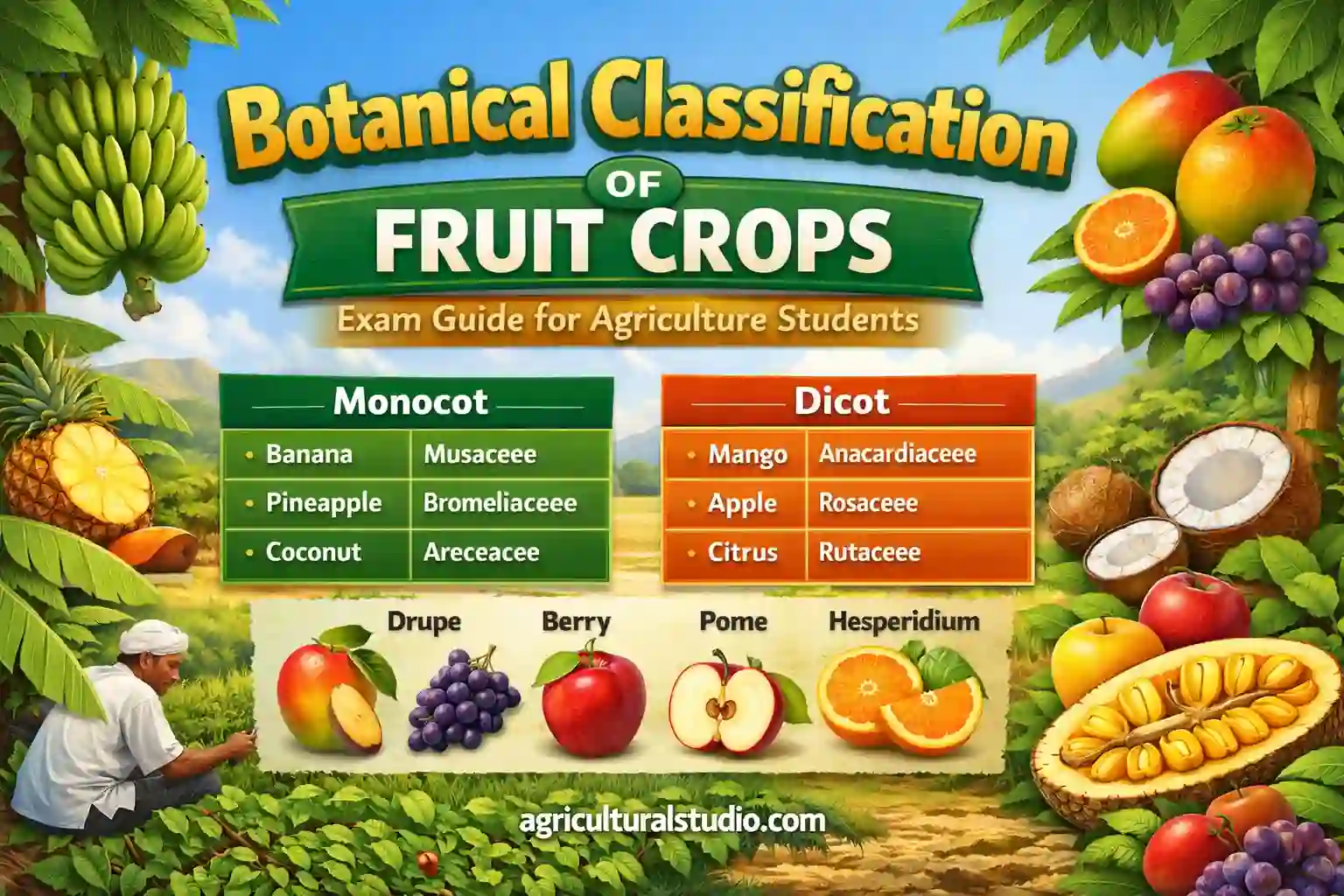
Fruit crops can also be grouped on the basis of botanical families.
👉 Read detailed explanation here: Botanical Classification of Fruit Crops
9. Classification Based on Breeding System
This topic is important for pollination and hybridization.
A. Self-Pollination (Autogamy)
- Cleistogamy: Flower does not open.
- Examples: Grape
- Homogamy: Male and female mature together.
- Examples: Apricot, Citrus, Peach, Phalsa
B. Cross-Pollination (Allogamy)
- Monoecious: Male and female flowers on same plant.
- Examples: Muscadine grape
- Dioecious: Male and female plants separate.
- Examples: Papaya, Kiwi, Pistachio
- Andromonoecious: Male and bisexual flowers on same plant.
Example: Mango - Gynodioecious: Female and bisexual plants.
Example: Fig - Heterodichogamy: Pecanut, Pistachio
- Self-Incompatibility: Plant cannot fertilize itself.
- Sporophytic: Mango, Aonla, Cocoa
- Gametophytic: Apple, Pear, Almond, Cherry, Ber
Aroma Compounds in Fruits
- Ripe apple – Ethyl-2-methylbutyrate
- Green apple – Hexenal
- Ripe banana – Eugenol
- Overripe banana – Isopentanol
- Grapefruit – Nootkatone
- Lemon – Citral
- Orange – Valencene
Conclusion
Classification of fruit crops in Horticulture is not just theory. It helps us understand:
Where to grow a fruit
- How it ripens
- How to manage pollination
- Why some fruits bear alternately
- What part we actually eat
For exams, focus especially on:
- Climacteric vs Non-climacteric
- Edible portions
- Acids in fruits
- Dichogamy
- Alternate bearing
Keep revising. Fruit science is scoring if prepared properly. 🌱

Leave a Reply