

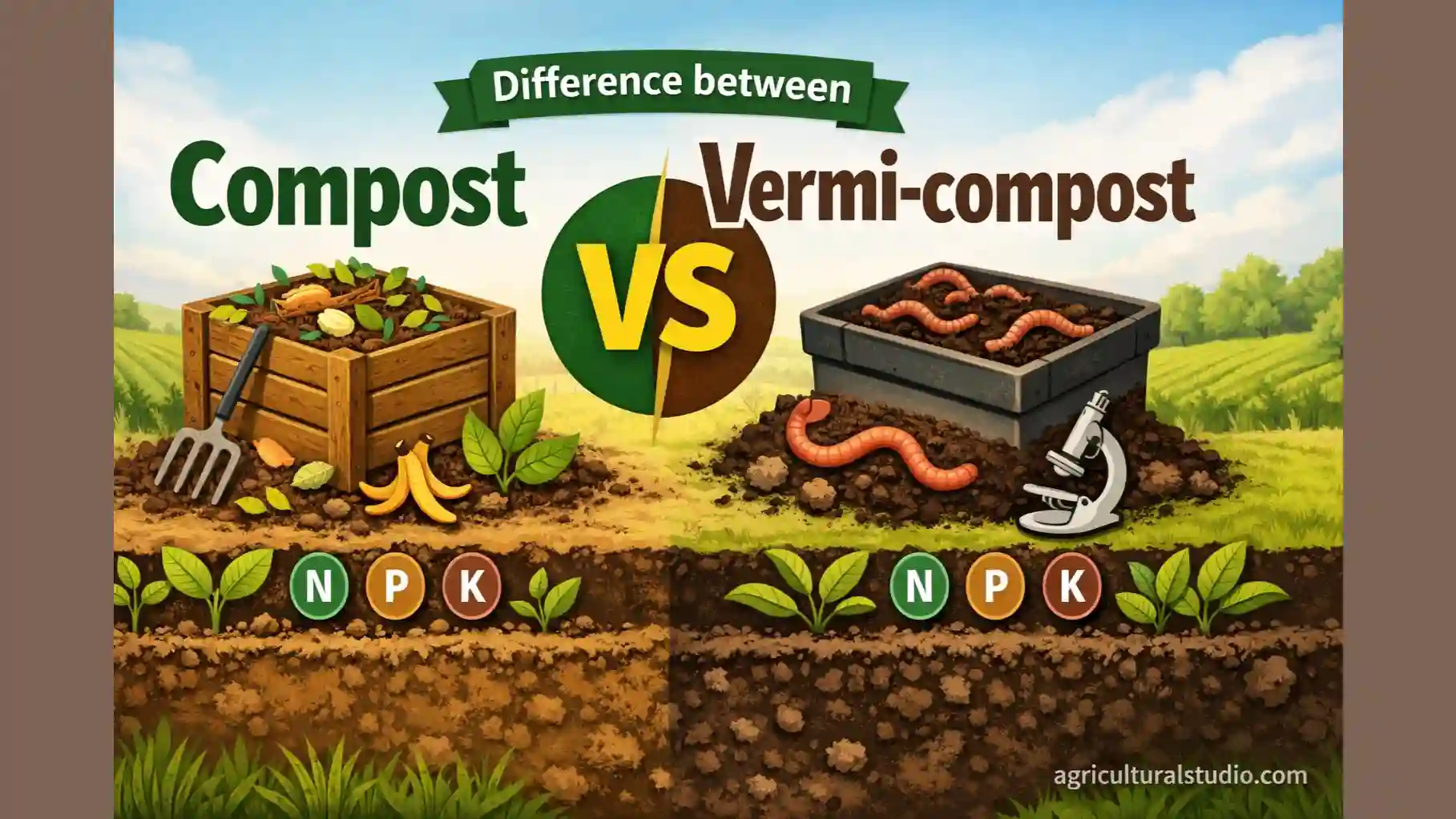
Today, organic farming is growing fast in India. Farmers and students are now giving more importance to soil health instead of only using chemical fertilizers. In this process, compost and vermicompost play a very important role.
But many students get confused between these two, especially during exams.
So, let us understand the difference between compost and vermicompost in very simple, clear, and practical language just like a teacher explaining in class.
This topic is part of our Agronomy Notes for agriculture students.
Compost vs Vermicompost: Simple Comparison
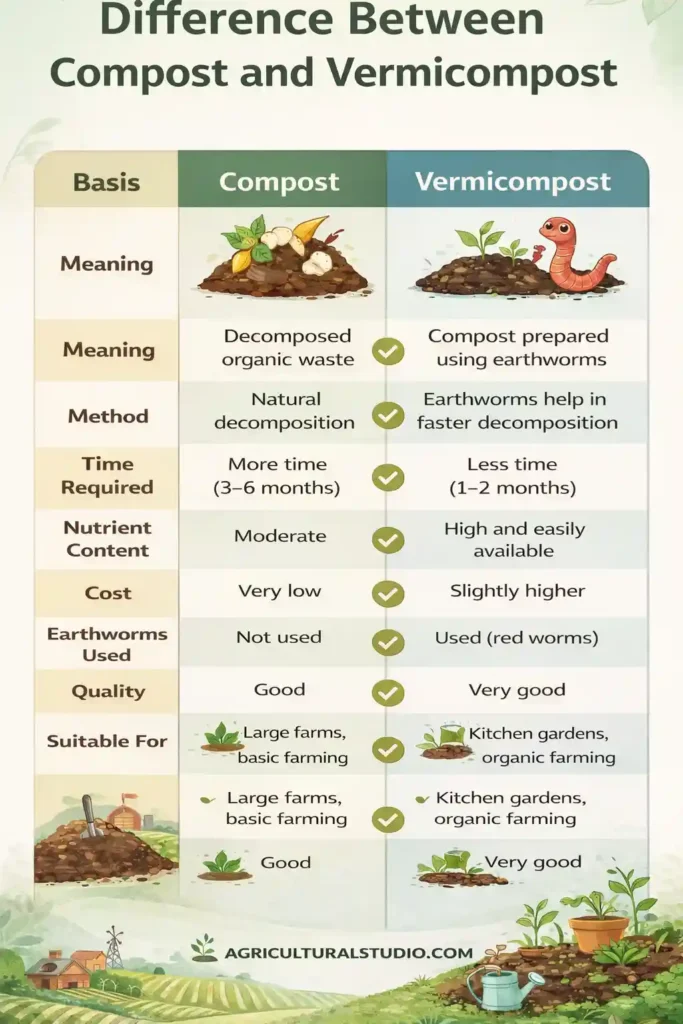
| Basis | Compost | Vermicompost |
|---|---|---|
| Basic idea | Compost is manure formed when organic waste breaks down on its own. | Vermicompost is manure made when earthworms process organic waste. |
| Process involved | Waste is kept in a pit or heap and left to decompose naturally. | Earthworms eat the waste and convert it into fine manure. |
| Use of living organisms | Only natural microbes work slowly in compost | Earthworms actively speed up the process. |
| Time taken | Needs a longer period, usually several months. | Prepared in a much shorter time. |
| Speed of preparation | Slow because decomposition happens naturally | Fast because earthworms digest the waste quickly |
| Nutrient strength | Nutrients are present but not in high quantity. | Nutrients are higher and more effective for plants. |
| Nutrient release | Nutrients become available to plants slowly. | Nutrients are easily available to roots. |
| Manure texture | Rough and bulky in nature | Soft, fine, and soil-like. |
| Manure quality | Useful for general soil improvement. | Very effective for plant growth and yield. |
| Cost factor | Very cheap and easy to prepare on farms. | Slightly costlier due to worm management. |
| Best use | Suitable for large agricultural fields. | Best for gardens, nurseries, and vegetables. |
| Effect on crops | Improves soil slowly over time. | Shows quicker and better crop response. |
| Indian farm example | Farmers use compost in wheat and rice fields. | Farmers use vermicompost in tomato and chilli farming. |
What is Compost? (Easy Explanation)
Compost is a natural manure prepared by decomposing organic waste like plant remains and animal dung.
This process happens slowly with the help of tiny organisms present in soil, such as bacteria and fungi.
Common materials used to make compost:
- Dry leaves
- Crop residues (stubble, straw)
- Cow dung
- Vegetable and fruit waste
- Farm waste
In very simple words:
👉 Compost wo khaad hoti hai jo patte, ghaas, fasal ka bacha hua hissa aur gobar ke sadne se banti hai.
What is Vermicompost? (Easy Explanation)
Vermicompost is a rich organic manure made with the help of earthworms.
Earthworms eat organic waste and convert it into fine, black, and nutrient-rich manure.
This manure contains:
- More nitrogen
- More phosphorus
- More potassium
- Useful microbes for soil
In very simple words:
👉 Vermicompost wo khaad hai jo kechuve (earthworms) ki madad se banai jaati hai aur zyada taakatwar hoti hai.
Compost vs Vermicompost: Key Points to Remember
- Compost is prepared naturally, vermicompost needs earthworms
- Compost takes more time, vermicompost is faster
- Vermicompost is richer in nutrients
- Compost is cheaper and easy to prepare
- Vermicompost improves soil structure and plant growth more effectively
👉Exam tip:
If asked “which is better?”,
Write: Both are useful, choice depends on purpose.
Which One Should You Use?
Both compost and vermicompost are good. The choice depends on land size, crop, and budget.
For small farmers and kitchen gardens:
- Vermicompost is better
- Gives faster results
- Ideal for vegetables and flowers
For large farms and low-budget farming:
- Compost is enough
- Easy to prepare in bulk
- Improves soil health slowly but steadily
Example: A vegetable farmer in Uttar Pradesh uses vermicompost for tomato and chilli to get better yield.
At the same time, wheat farmers use compost in large fields to maintain soil fertility at low cost.
May you like this 👉➡️ वर्मी कम्पोस्ट क्या है? बनाने की विधि, फायदे, उपयोग और बिजनेस प्लान | Vermicompost Guide in Hindi
Importance of Compost and Vermicompost in Agriculture
Compost and vermicompost are very important in farming, especially in India where soil health is slowly declining due to excess chemical use. These organic manures help farmers grow healthy crops in a natural and safe way. Below are the main points explaining their importance, written in a simple and student-friendly tone.
1. Improve Soil Fertility
Compost and vermicompost add organic matter to the soil. This organic matter supplies essential nutrients needed for plant growth. Compost releases nutrients slowly, while vermicompost provides them faster. Regular use makes soil fertile for a long time.
2. Improve Soil Structure
These manures make the soil soft and well-aerated. In clay soil, they reduce hardness, and in sandy soil, they help bind particles together. This creates a better environment for root growth and nutrient absorption.
3. Increase Water Holding Capacity
Soil mixed with compost or vermicompost can hold water for a longer time. This reduces moisture stress during dry periods and lowers the need for frequent irrigation. It is very helpful in rain-fed farming areas.
4. Reduce Dependence on Chemical Fertilizers
Using compost and vermicompost reduces the need for chemical fertilizers. This saves money and prevents long-term damage to soil. Farmers often use them to maintain balance in the soil.
5. Improve Crop Growth and Yield
Vermicompost especially helps in better seed germination, strong plant growth, and higher yield. Crops grow uniformly and show better resistance to stress. Vegetables and fruits respond very well to vermicompost application.
6. Improve Quality of Produce
Crops grown with organic manure have better taste, colour, and shelf life. This is why organic vegetables and fruits get a better price in the market.
7. Increase Beneficial Soil Microorganisms
Vermicompost contains many helpful microbes. These microbes improve nutrient availability and keep the soil biologically active. Healthy soil microbes mean healthier crops.
8. Eco-Friendly and Sustainable
Compost and vermicompost recycle farm and kitchen waste. They reduce pollution and protect the environment. Their use supports sustainable agriculture and long-term soil health.
Exam Point of View (Very Important)
For 1 Mark Answer:
Compost is organic manure prepared by decomposition of waste, while vermicompost is prepared using earthworms.
For 2 Mark Answer:
Vermicompost is richer in nutrients and prepared faster than compost with the help of earthworms, while compost takes more time and has moderate nutrients.
Conclusion
Compost and vermicompost are essential for healthy soil and good crops. Compost is useful for long-term soil improvement, while vermicompost gives faster results. Using both together helps Indian farmers increase yield, save costs, and protect the environment.
👉 Healthy soil = Healthy crops = Sustainable farming 🌱
Frequently Asked Questions (FAQs)
What is the main difference between compost and vermicompost?
The main difference is that vermicompost is prepared using earthworms, while compost is not.
Which is better for plants?
Vermicompost is better because nutrients are easily available to plants.
Is vermicompost costly?
It is slightly costlier than compost but gives better growth and yield.
Can both be used together?
Yes, using both together improves soil health and crop performance.


Leave a Reply