

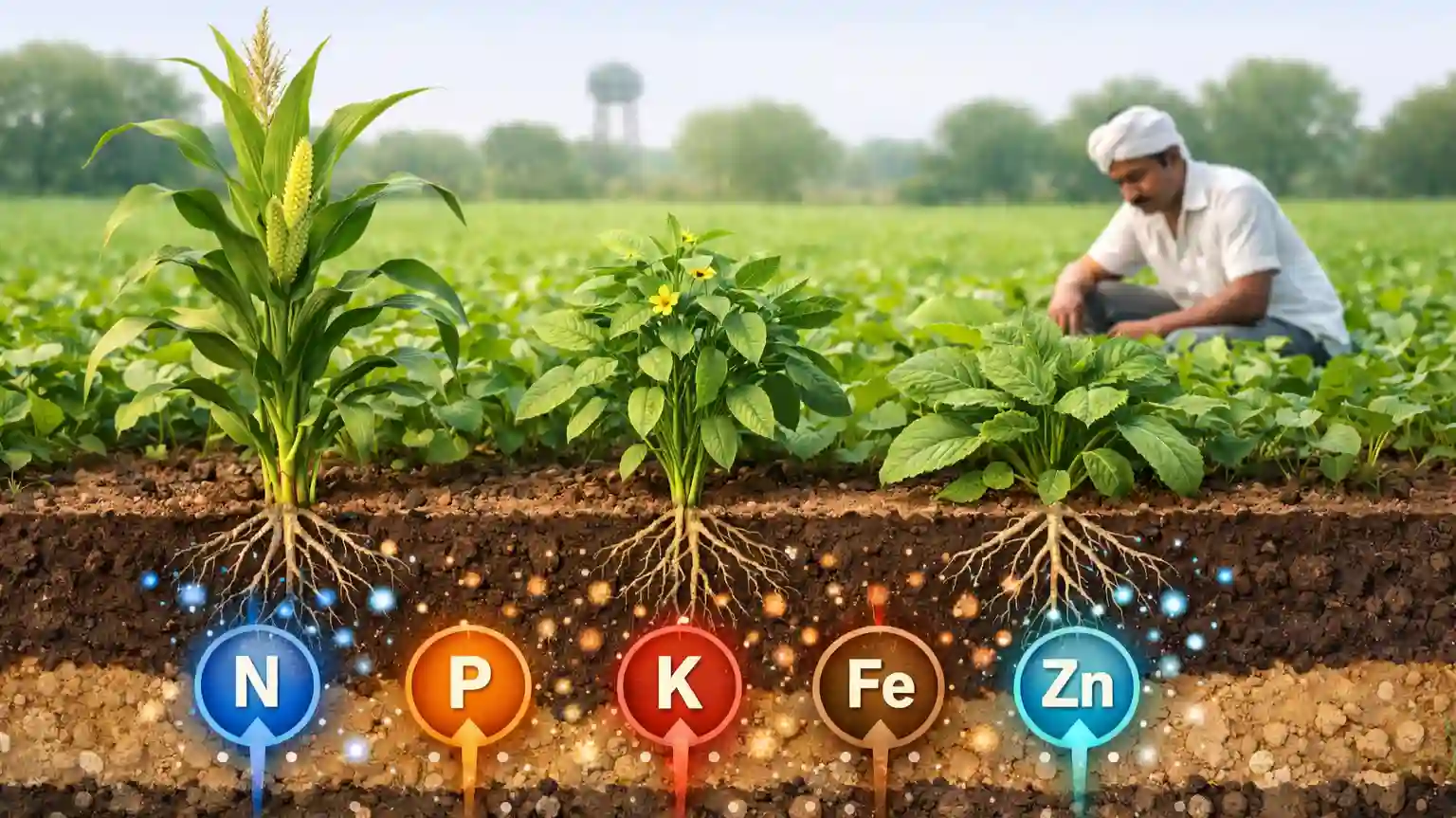
Plant nutrients are essential for normal plant growth and development. When any nutrient becomes insufficient, plants show visible deficiency symptoms. These symptoms vary depending on the nutrient involved and the age of the affected plant part.
Common Deficiency Symptoms
1.Chlorosis :- Chlorosis refers to the loss or reduction of chlorophyll in leaves, resulting in yellowing. It mainly affects photosynthesis and overall plant health.
2. Necrosis :- Necrosis is the death of plant tissues. It appears as brown or black dead patches on leaves, along margins, or between veins.
3. Discolouration :- Discolouration indicates a change in the normal green colour of leaves, such as purple, reddish, or bluish shades.
4. Stunted Growth :- Due to nutrient deficiency, plant growth may slow down or stop partially or completely, leading to short plants with poor yield.
This topic is part of our Agronomy Notes for agriculture students.
Parts of a Leaf (Diagram Explanation)
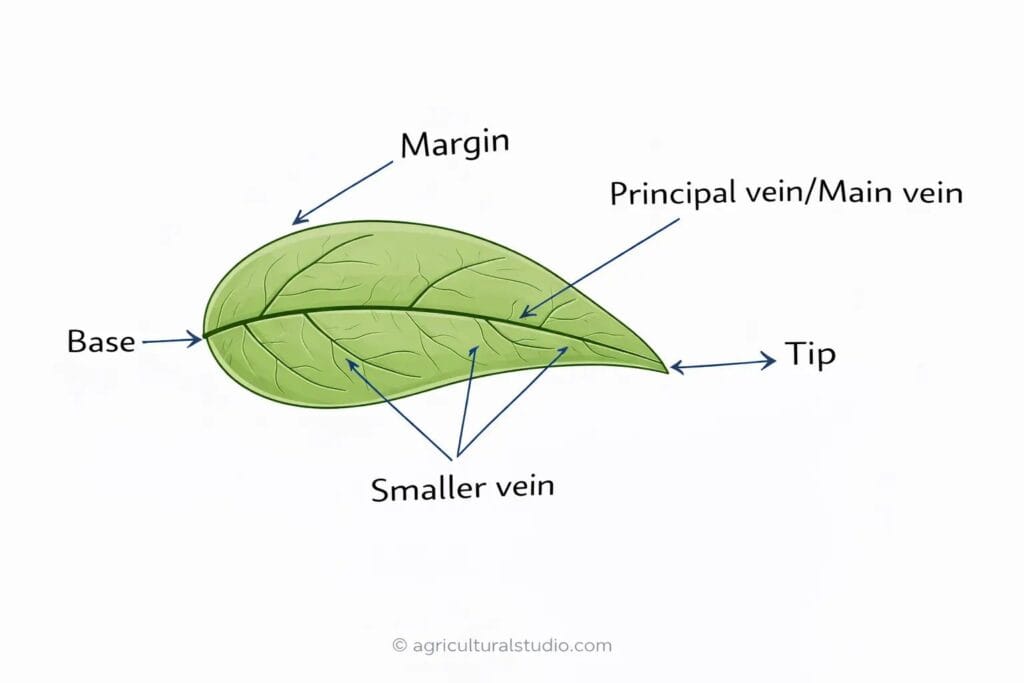
- Base – The portion where the leaf attaches to the stem.
- Margin – The outer edge of the leaf.
- Tip – The terminal end of the leaf.
- Principal (Main) Vein – The central vein running through the leaf.
- Smaller Veins – Branches arising from the main vein that distribute nutrients.
Nutrient Deficiency Based on Leaf Age
A. Deficiency on Older Leaves / Lower Leaves
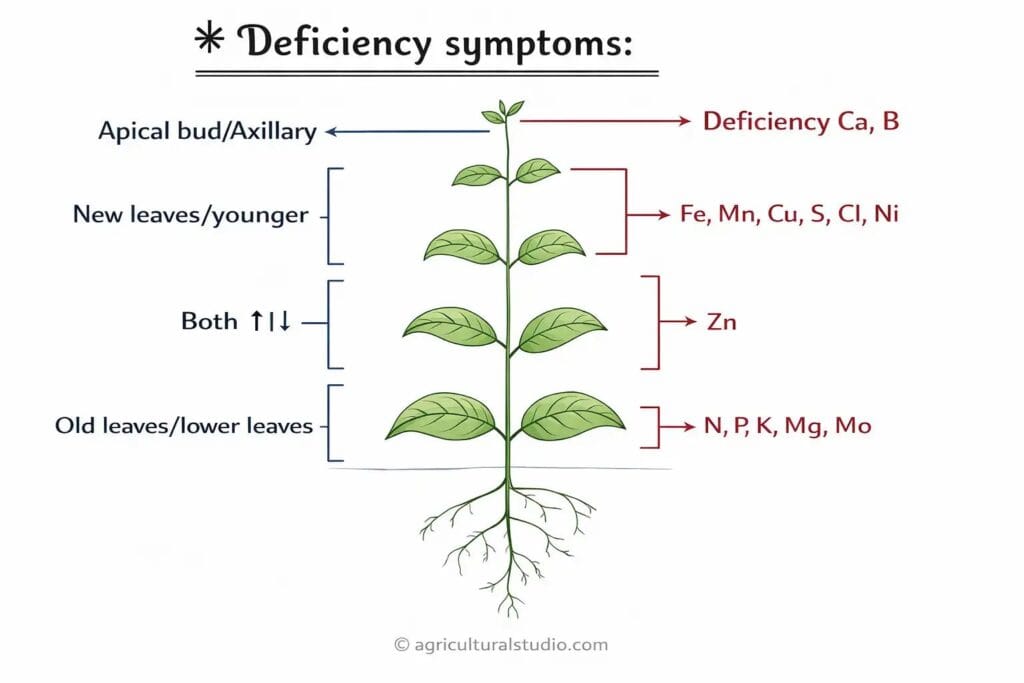
Nutrients that move easily within the plant show deficiency symptoms first in older leaves.
Common deficiencies: Nitrogen (N), Phosphorus (P), Potassium (K), Magnesium (Mg), Molybdenum (Mo)
(1) Chlorosis in Older Leaves
V-shaped Chlorosis in Cereals
- Caused by Nitrogen deficiency.
- Yellowing begins from the leaf tip.
- Both main and smaller veins turn yellow.
Interveinal Chlorosis
- Caused by Magnesium deficiency
- Yellowing appears between veins
- Veins remain green.
(2) Necrosis in Older Leaves
- Potassium deficiency → Drying and death along leaf margins.
- Molybdenum deficiency → Dead patches between leaf tissues.
(3) Discolouration / Pigmentation
- Discoloration in leaves Due To phosphorus deficiency.
- Leaves change colour from green to purple or reddish, especially under cool conditions.
B. Deficiency on New Leaves / Upper Leaves / Younger Leaves
Immobile nutrients show deficiency symptoms first in young leaves.
Common deficiencies: Copper (Cu), Sulphur (S), Manganese (Mn), Iron (Fe), Chlorine (Cl), Nickel (Ni)
Chlorosis in Younger Leaves
Chlorosis in younger leaves shows two different types. When the veins become yellow, it is called yellow vein chlorosis. When the veins remain green, it is known as green vein chlorosis. Both types are explained in detail below.
(a) Yellow Veins
- Due to Sulphur Deficiency Leaves show a mottled yellow-green colour and Veins also turn yellow.
- Due to Copper Deficiency White tip appears on the youngest leaf and Leaves twist and wilt.
(b) Green Veins
(i) Principal Vein Green
- Caused by iron deficiency
- Known as complete internal chlorosis.
- Leaves appear pale yellow or whitish with a green midrib.
(ii) Principal and Smaller Veins Green
- Caused by Manganese deficiency.
- Known as interveinal chlorosis.
- Brown or black specks appear.
- Common in legumes and potato crops.
Note 🎯:-
✅Nitrogen and Sulphur both shown yellow colour on leaf but the main difference is Sulphur deficiency appears on new leaves and
Nitrogen deficiency appears on old leaves. because Nitrogen is a mobile nutrient, so it moves from older leaves to new growth yellowing starts in old leaves.and Sulphur is less mobile, so deficiency symptoms appear in young leaves.
✅A similar comparison applies to magnesium (old leaves) and manganese (new leaves).
C. Old and New Leaves (Both Affected)
Zinc Deficiency
- Zinc deficiency Causes chlorosis and necrosis together.
- Results in poor internode elongation and stunted plant growth.
D. Apical Bud Symptoms
Deficiency of calcium (Ca) and boron (B) mainly affects growing points.
Calcium Deficiency
- Chlorosis is the primary symptom.
- Necrosis is secondary.
- Symptoms progress from the leaf tip to the base.
Boron Deficiency
- Symptoms progress from the base to the tip.
- The youngest leaf becomes brown or dies.
- Commonly observed in sugarcane and sugar beet.
You can understand nutrients deficiency in image clearly 👇
Functions of Plant Nutrients
Classification Based on Function
- Structural Components :- C, H, O, N, P, S – Form the basic structure of plant cells and tissues.
- Enzyme Activators :- K, Ca, Mg, Mn, Zn – Activate enzymes involved in metabolic processes.
- Ballast Elements :- Si, Al – Strengthen plant structure but are not essential for all plants.
- Primary Deficiency Elements :- Nitrogen (N), Phosphorus (P), Potassium (K)
Individual Nutrients and Their Functions
Nitrogen (N)
- Forms amino acids, proteins, RNA, DNA, enzymes, and alkaloids
- Essential component of chlorophyll
- Helps plants convert carbon dioxide into carbohydrates using sunlight
- Improves the quality of leafy vegetables and fodder crops.
Phosphorus (P)
- ATP acts as the energy currency of plants
- Components of nucleic acids, phytin, and phospholipids
- Plays a key role in energy storage and transfer
Potassium (K)
- Regulates opening and closing of stomata
- Maintains water balance and improves stress tolerance
Calcium (Ca)
- Activates enzymes such as phospholipase, amylase, ATPase, and arginine kinase
- Important for cell wall stability and root development
Magnesium (Mg)
- Central element of chlorophyll (15–20%).
- Activates RuBisCO (C₃ plants) and PEPC (C₄ plants).
- Essential for carbon fixation.
Zinc (Zn)
- Required for synthesis of auxin (IAA).
- Involved in gibberellic acid metabolism.
- Plays a role in RNA synthesis
Molybdenum (Mo)
- Structural part of nitrogenase, nitrate reductase, and nitrite reductase.
- Important for nitrogen metabolism.
Nickel (Ni)
- Activates the urease enzyme.
- Helps in the conversion of urea into usable nitrogen.
Boron (B)
- Essential for pollen formation and germination
- Important for reproductive growth
Chlorine (Cl)
- Maintains osmotic balance
- Required for photosynthesis
- Excess chlorine is associated with suppression of diseases such as:
- Grey leaf spot (coconut)
- Root rot (wheat, barley)
- Stalk rot (maize)
- Sheath blight and stem rot (rice)
- Downy mildew (millet)
Sulphur (S)
- Essential for oil synthesis in oilseed crops
- Part of cysteine, cystine, and methionine
- Also present in glucosides.
🎯For a detailed explanation of essential elements and their classification, refer to Plant Nutrients: Essential Elements, Classification and Soil pH.
frequently Asked questions ❓ (FAQ)
Why do nutrient deficiency symptoms appear on different leaves?
Deficiency symptoms depend on nutrient mobility. Mobile nutrients like nitrogen show symptoms first on older leaves, while immobile nutrients like iron and calcium affect younger leaves.
What is chlorosis in plants?
Chlorosis is the yellowing of leaves due to reduced chlorophyll formation. It directly affects photosynthesis and overall plant growth.
How can nitrogen deficiency be identified in crops?
Nitrogen deficiency is identified by yellowing starting from the tips of older leaves, reduced tillering, and overall weak plant growth.
What is the difference between nitrogen and sulphur deficiency?
Nitrogen deficiency appears first on older leaves, while sulphur deficiency affects younger leaves. Both cause yellowing, but leaf position helps in identification.
Exam-oriented handwritten notes | PDF format
Download Notes | PDF format👇
These handwritten, exam-oriented notes are available only for registered students.To download the PDF, please register or log in first.

Leave a Reply