

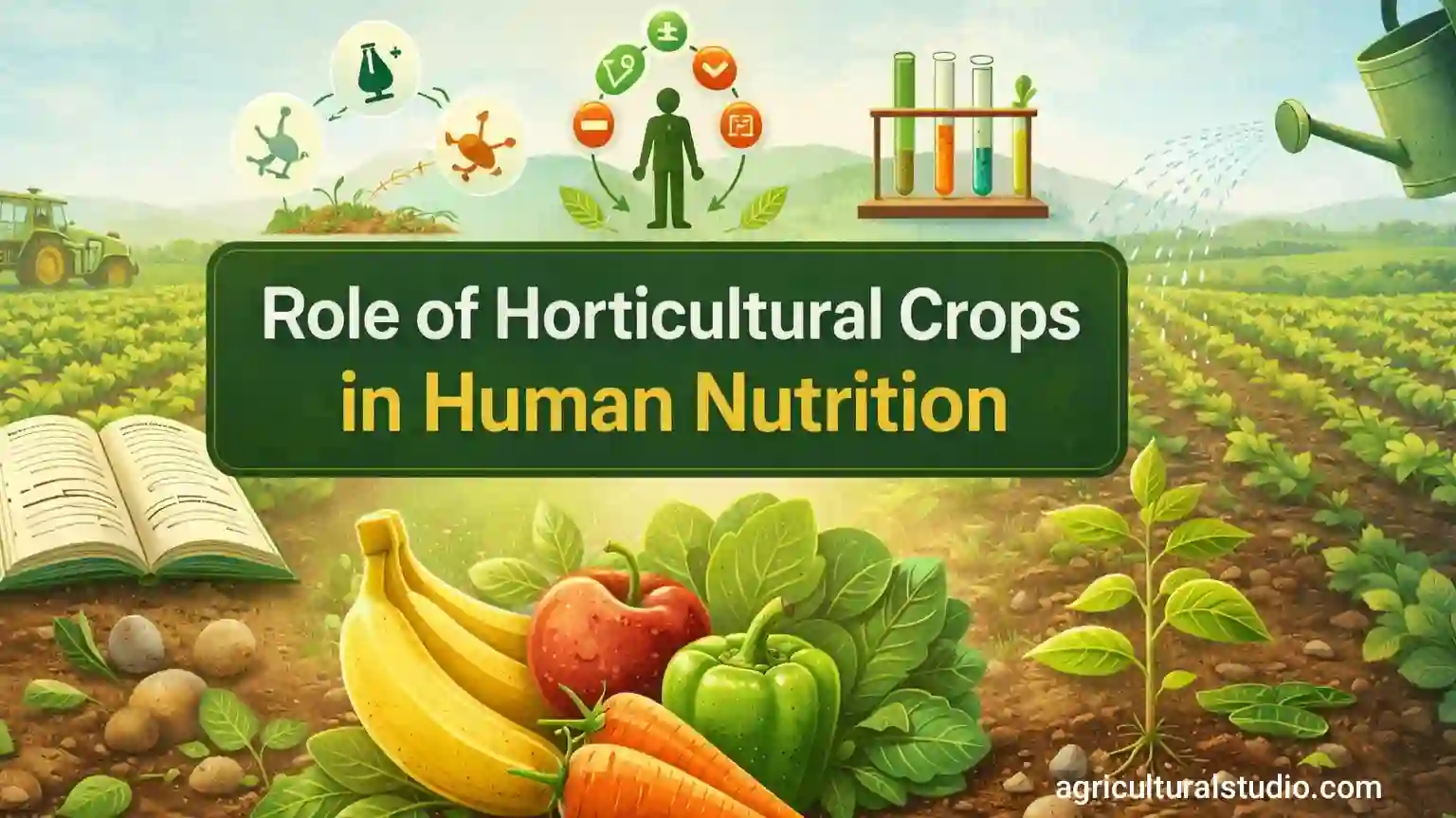
When we talk about a healthy diet, fruits and vegetables always come first. They are called horticultural crops, The role of horticultural crops in human nutrition is very important because fruits and vegetables supply carbohydrates, proteins, vitamins and minerals for a healthy life and they play a big role in keeping our body fit and active.
In India, we grow many fruits like mango, banana, guava, and vegetables like potato, carrot, spinach, and sweet potato. These crops do not just fill our stomach, they supply energy, proteins, vitamins, and minerals that our body needs every day.
This topic is part of our Horticulture Notes series for agriculture students
Let us study this step by step in simple language.
Table of Contents
Role of horticultural crops in human nutrition
1. Carbohydrates
What are carbohydrates?
Carbohydrates are the main source of energy for our body. When we eat foods rich in carbohydrates, our body converts them into glucose, which gives us strength to work, walk, and think. It’s an important role in human nutrition.
Types of carbohydrates
Carbohydrates are divided into three main groups:
(a) Monosaccharides (simple sugars)
These are the simplest form of sugar and are easily absorbed by the body.
Examples: Glucose, Fructose, Mannose
These sugars are mostly found in fruits. For example, the sweetness of grapes and apples comes from fructose and glucose.
(b) Disaccharides (double sugars)
These are made by joining two simple sugars.
Examples: Sucrose (table sugar), Lactose (milk sugar), Maltose
Sugarcane and beet sugar mainly contain sucrose.
(c) Polysaccharides (complex carbohydrates)
These are long chains of sugar units.
Examples: Starch, Cellulose, Tapioca (cassava product)
Starch is very important because it provides long-lasting energy. Cellulose helps in digestion.
Fruit sources of carbohydrates
Some fruits are very rich in carbohydrates, especially dry fruits.
- Raisins – 77.3%
- Dry apricot – 72.8%
- Date palm – 67.3%
- Dry karonda – 67.1%
- Banana – 36.4%
- Bael – 30.6%
Banana is cheap and easily available in India. Farmers and laborers eat banana for quick energy. Dates are also common during fasting because they give instant energy.
Vegetable sources of carbohydrates
- Tapioca (cassava) – 38.1%
- Sweet potato – 28.2%
- Potato – 22.6%
In tribal areas of India, tapioca and sweet potato are staple foods because they grow easily and give high energy. These are the Role of fruits and vegetables in human nutrition.
2. Proteins
What are proteins?
Proteins are body-building nutrients. They help in Growth of body, Repair of tissues, Formation of muscles, Making enzymes and hormones.
They are nitrogen-containing organic compounds and are a major part of cell protoplasm.
Daily protein requirement: About 60–70 g per person per day.
Fruit sources of protein
Nuts are the best fruit sources of protein.
- Cashew nut – 21.20%
- Almond – 20.88%
- Walnut – 15.60%
Cashew is grown in Kerala and Goa. Almonds and walnuts are used during winter for strength and warmth.
Vegetable sources of protein
- Lima bean – 7.9 g/100 g
- Pea – 7.9 g/100 g
- Cowpea – 4.3 g/100 g
Pea and cowpea are common vegetables in Indian villages. They are cheap and provide protein to poor families.
Per capita requirement and availability of foods
According to FAO, This table shows how much food is required and how much is available per person per day:
| Food item | Requirement | Availability |
|---|---|---|
| Cereals | 400 g | 444 g |
| Pulses | 80 g | 47 g |
| Vegetables | 300 g | 378 g |
| Fruits | 120 g | 200 g |
| Milk | 300 g | 410 g |
| Oil | 30–35 g | — |
Important point:
Pulses are less available than required, which causes protein deficiency in many people. Fruits and vegetables are more available, which is good for vitamin supply.
3. Vitamins
Vitamins protect us from diseases and keep body functions normal.
Types of vitamins
- Water-soluble vitamins: Vitamin B-complex, Vitamin C
- These dissolve in water and are not stored in the body for long.
- Fat-soluble vitamins: Vitamin A, Vitamin D, Vitamin E, Vitamin K
- These are stored in body fat.
| Vitamin | Type | Main Functions | Deficiency Disease / Symptoms | Major Sources (Horticultural) | Special Name |
|---|---|---|---|---|---|
| Vitamin A (Retinol / Carotene) | Fat-soluble | – Good vision – Healthy skin – Growth of body | – Night blindness – Xerophthalmia (dry eyes in children) | Mango, Papaya, Carrot, Green leafy vegetables | Eye vitamin |
| Vitamin D (Cholecalciferol) | Fat-soluble | – Strong bones – Helps calcium absorption | – Rickets (children) – Osteomalacia (adults | Sunlight (main), milk, egg yolk | Sunshine vitamin |
| Vitamin E (Tocopherol) | Fat-soluble | – Protects body cells – Reproductive health | – Kidney damage – Liver tissue damage | Sweet corn, Onion, vegetable oils | Anti-sterility vitamin / Beauty vitamin |
| Vitamin K (Phylloquinone) | Fat-soluble | Blood clotting – Prevents bleeding | – Delayed blood clotting – Excess bleeding | Green leafy vegetables (spinach, cabbage, fenugreek) | Anti-hemorrhagic vitamin |
| Vitamin C (Ascorbic acid) | Water-soluble | Increases immunity – Wound healing – Healthy gums | – Scurvy – Bleeding gums – Weakness | Amla, Guava, Citrus fruits, Barbados cherry | Anti-scurvy vitamin |
Vitamin B-Complex(Water Soluble)
| Vitamin | Common Name | Main Functions | Deficiency Symptoms | Important Sources (Horticultural) |
|---|---|---|---|---|
| B₁ | Thiamine | Helps in energy production and nerve function | Beriberi, muscle weakness, loss of appetite, nerve problems | Beet, papaya, cashew, almond, walnut |
| B₂ | Riboflavin | Maintains healthy skin and eyes | Cracks at mouth corners, dry scaly skin, sore lips | Beet, papaya, cashew |
| B₃ | Niacin (Nicotinic acid) | Helps in digestion and nervous system | Pellagra, diarrhea, mental confusion | Vegetables, nuts, fruits |
| B₅ | Pantothenic acid | Needed for fat and carbohydrate metabolism | Fatigue, digestive problems (rare) | Vegetables, nuts |
| B₆ | Pyridoxine | Brain development and protein metabolism | Low energy, poor brain function, anemia | Spinach, bell pepper, squash, turnip greens |
| B₇ | Biotin (Vitamin H) | Healthy hair, skin, and metabolism | Hair loss, skin rash (rare) | Vegetables, nuts |
| B₉ | Folic acid | Formation of red blood cells | Anemia, weakness | Green leafy vegetables, beet |
| B₁₂ | Cyanocobalamin | Formation of RBCs and nerve health | Pernicious anemia, nerve damage | Not in fruits & vegetables (animal foods only) |
Easy Memory Tips
A = Aankh (eye)
D = Dhoop (sunlight)
E = Energy & beauty
K = Khoon jamna (blood clotting)
C = Citrus & scurvy
4. Minerals
Minerals are needed in small amounts but are very important.
Calcium
- Daily requirement: 500–600 mg/day
- Sources: Litchi, Karonda
- Helps in: Strong bones and Teeth formation
Iron
Sources: Dried karonda, Dates
Iron prevents anemia and helps in oxygen transport.
Phosphorus
- Sources: Almond, Cashew, Walnut
- Helps in: Bone formation, Energy transfer
Conclusion
Horticultural crops are not only tasty but also life-saving foods. They supply:
- Carbohydrates for energy
- Proteins for growth
- Vitamins for disease prevention
- Minerals for strong bones and blood
In India, where fruits and vegetables are easily available, people should include them in daily meals. Crops like banana, guava, amla, carrot, spinach, and sweet potato can improve health at low cost. That’s why the role of horticultural crops in human nutrition is very important.
For agriculture students, this topic shows how farming and human health are connected. Growing fruits and vegetables is not only good for farmers’ income but also for national nutrition and food security.
In simple words, horticulture supports healthy life and plays a major role in human nutrition.

Leave a Reply