

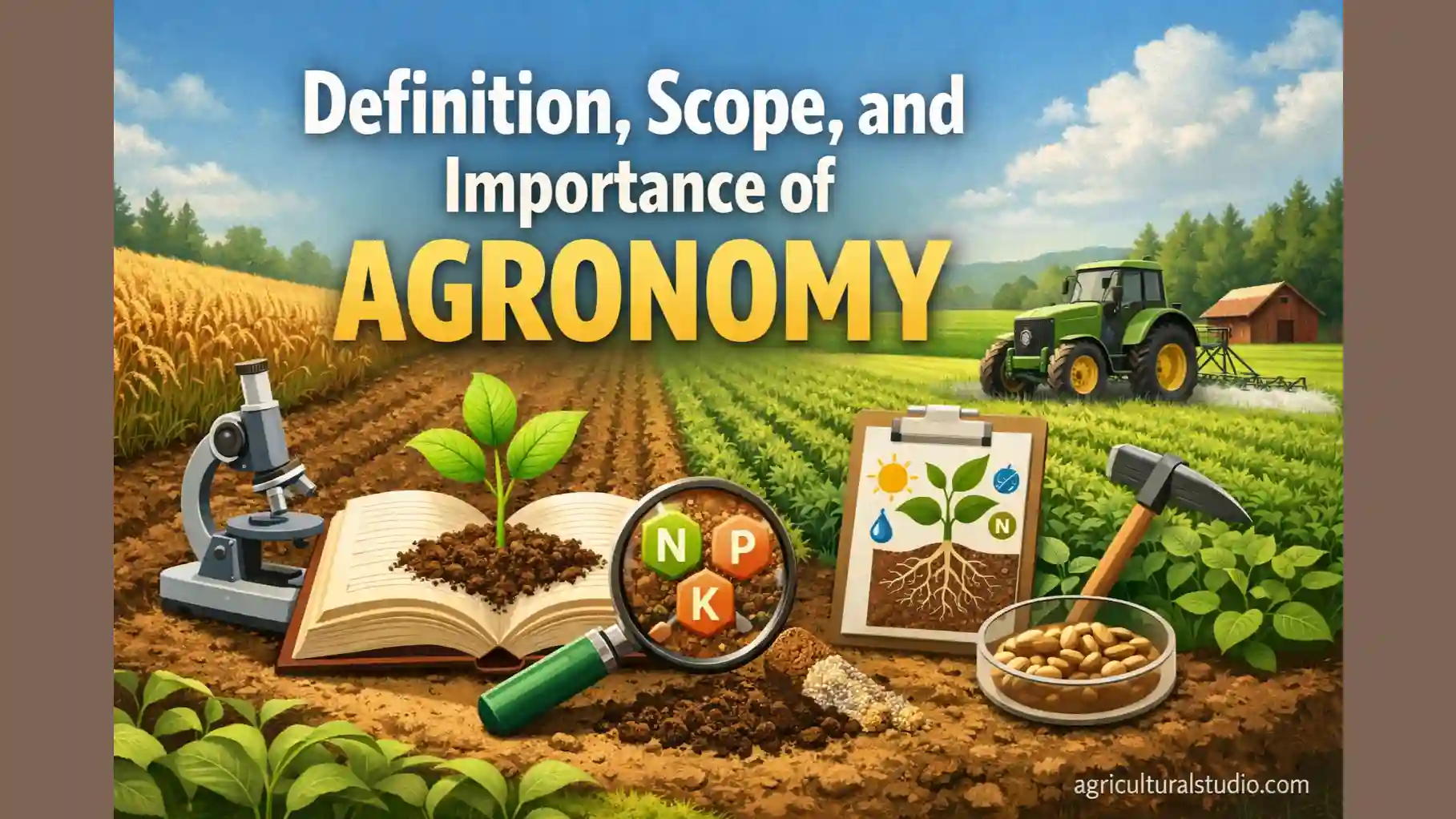
When we talk about agriculture, most people think only about crops growing in fields. But behind every healthy crop, there is proper planning, correct timing, and scientific decision-making. This is where agronomy comes in. So in this Article we will know about Scope and importance of Agronomy.
As a Writer, I often tell readers one simple thing:
👉 Agronomy teaches us how to grow crops wisely, not blindly.
In a country like India, where farming supports millions of families and feeds a huge population, agronomy plays a very important role. Our soils are different, climates change every few kilometers, and water is limited in many areas. Agronomy helps farmers adjust their practices according to these conditions.
In this blog, we will clearly understand:
- What agronomy really means?
- What comes under the scope of agronomy?
- Why agronomy is so important for farmers, students, and the nation?
Everything is explained step by step, in easy language, with practical Indian examples.
This topic is part of our Agronomy Notes for agriculture students.
Definition of Agronomy
Agronomy is a branch of agricultural science that deals with crop production and soil management.
In very simple words:
👉 Agronomy studies how to grow crops properly using land, water, nutrients, and climate in the best possible way.
Agronomy tries to answer very practical questions that every farmer faces, such as:
- Which crop should be grown in this soil?
- When is the best time to sow the crop?
- How should the field be prepared?
- How much fertilizer and water does the crop actually need?
- How can weeds be controlled without damaging the crop?
Agronomy does not work in isolation. It uses knowledge from Soil science, Crop physiology, Weather and climate studies and Farm management.
The main aim is higher yield with lower damage to soil and environment.
A simple way to remember the definition for exams is:
Agronomy is the science and art of growing crops and managing soil for sustainable and higher production.
Nature of Agronomy
We saw in the definition that agronomy has a dual nature—”it is both an art and a science.”
1. Agronomy as a Science
It is a science because:
- It is based on experiments
- Results are tested in research farms
- Recommendations are given after proper trials
For example, fertilizer doses are not guessed. They are decided after soil testing and field experiments.
2. Agronomy as an Art
It is also an art because:
- Farmers apply knowledge according to local conditions
- One practice may not work the same everywhere
- Experience plays an important role
A farmer in Rajasthan cannot follow the same practices as a farmer in Punjab. Adjusting techniques makes agronomy an art.
Dynamic Nature
Agronomy keeps changing with time.
Old practices are replaced by better ones.
Example:
Flood irrigation → Drip irrigation
Deep ploughing every year → Minimum tillage
Excess fertilizers → Balanced nutrient management
Scope of Agronomy
The scope of agronomy is very wide. It covers almost everything related to crop production from field preparation to harvesting.
Let us understand its major areas one by one.
1. Crop Production Practices
This area focuses on how crops are grown in the field. It includes choosing the right crop and variety, deciding the correct sowing time, using proper spacing, and following suitable cropping patterns to get better yield.
Example: In dryland areas of Maharashtra and Karnataka, crops like sorghum, pearl millet, and pigeon pea are preferred because they require less water. Rice is usually avoided in these regions due to limited rainfall. This shows how agronomy helps match the right crop with the right region.
2. Soil Management
Soil management deals with keeping the soil healthy and productive. It includes proper tillage, maintaining soil fertility, improving soil structure, and protecting the soil from erosion so that crops can grow well.
Example: In many parts of North India, zero tillage in wheat after rice is widely practiced. This method saves time and fuel and also improves soil structure. Farmers also use farmyard manure and green manuring crops like dhaincha to improve soil fertility.
3. Water Management
Water management explains how to use irrigation water carefully and efficiently. It helps farmers decide when to irrigate, how much water to apply, and which irrigation method is best for different crops and regions.
Example: In states like Maharashtra and Gujarat, drip irrigation is commonly used in vegetables and fruit crops. Mulching is also practiced to reduce water loss from soil. In dry regions, rainwater harvesting helps farmers store water for critical crop stages.
4. Weed Management
Weed management focuses on controlling unwanted plants that compete with crops for nutrients, water, light, and space. Agronomy studies different weed control methods to reduce crop losses without harming the environment.
Example: In rice and wheat fields, farmers commonly practice hand weeding and inter cultivation. Crop rotation is also used to reduce weed population. Limited and safe use of herbicides is recommended only when necessary.
5. Nutrient Management
Nutrient management deals with supplying crops with the right nutrients in the right way. It helps farmers use fertilizers properly so that crops grow healthy and soil fertility is maintained.
Example: In many Indian farms, excessive use of urea has reduced soil health. Agronomy promotes balanced fertilization using nitrogen, phosphorus, potassium, and organic manures. Soil testing is encouraged to avoid unnecessary fertilizer use.
6. Cropping Systems and Farming Systems
This area explains how different crops are grown in a planned manner over time and space. It also includes integrated farming systems where crops, animals, and other farm activities support each other.
Example: The rice–wheat system is common in the Indo-Gangetic plains. Intercropping of maize with cowpea is practiced to improve land use. Crop rotation with pulses helps in improving soil nitrogen content. Small farmers also follow integrated farming with crops, dairy, and poultry.
7. Climate-Smart Agriculture
Climate-smart agriculture focuses on adjusting farming practices to face problems like drought, floods, and rising temperatures. It helps farmers reduce crop losses due to climate change.
Indian example: In wheat-growing areas, early sowing of wheat helps avoid yield loss due to high temperature at maturity. Farmers also adopt moisture conservation practices to protect crops during dry spells.
8. Precision and Modern Agronomy
Modern agronomy uses new technologies to improve farming efficiency. It includes scientific tools and techniques that help farmers reduce input costs and increase productivity.
Indian example: Farmers are increasingly using soil testing, GPS-based fertilizer application, and mobile-based advisory services. Precision farming in vegetables and fruits helps apply inputs only where required.
Importance of Agronomy
Agronomy is important because it directly influences how crops are grown in farmers’ fields. It helps in improving crop production while protecting soil, water, and other natural resources. In a country like India, where agriculture supports a large population and most farmers have small land holdings, agronomy plays a key role in making farming productive and sustainable.
1. Helps in Increasing Crop Production
One of the main importance of agronomy is increasing crop yield. Agronomy provides scientific methods for proper land preparation, timely sowing, correct spacing, and efficient use of inputs. When farmers follow these practices, crops grow better and give higher yields.
2. Ensures Food Security
India has a large and growing population. Agronomy helps produce more food from limited agricultural land. By increasing productivity per unit area, agronomy supports national food security and reduces dependence on food imports.
3. Maintains Soil Health and Fertility
Continuous cropping without scientific management can damage soil. Agronomy promotes practices that protect soil fertility and structure. Healthy soil is necessary for sustainable crop production over a long period.
4. Promotes Efficient Use of Natural Resources
Agronomy teaches farmers how to use land, water, fertilizers, and seeds efficiently. Proper resource use reduces wastage and lowers the cost of cultivation.
5. Increases Farmers’ Income
Scientific agronomic practices help farmers increase yield and improve the quality of produce. At the same time, efficient input use reduces production costs, leading to higher net income.
6. Supports Sustainable Agriculture
Agronomy balances crop productivity with environmental protection. It encourages practices that reduce soil erosion, water pollution, and overuse of chemicals.
7. Helps Farmers Face Climate Change
Climate change has increased problems like drought, floods, and heat stress. Agronomy provides solutions to reduce crop losses by adjusting farming practices.
8. Reduces Risk in Farming
Agronomy helps reduce uncertainty in farming by guiding farmers on crop choice, cropping systems, and resource management. This reduces the risk of crop failure.
9. Provides Employment and Career Opportunities
Agronomy offers career opportunities in research, education, extension services, and agricultural industries. Agronomists play an important role in transferring scientific knowledge from research stations to farmers’ fields.
Conclusion
Agronomy is the foundation of crop production. It combines scientific knowledge with practical field experience to help farmers grow crops efficiently and sustainably.
The definition of agronomy focuses on crop production and soil management.
The scope of agronomy covers everything from land preparation to modern precision farming.
The importance of agronomy lies in food security, soil health, farmer income, and environmental protection.
For students of agriculture, a strong understanding of agronomy is essential. It not only helps in exams but also prepares you to solve real farming problems.
In the future, agronomy will become even more important as we face challenges like climate change, population growth, and resource scarcity.
👉 Strong agronomy means strong agriculture.
Check all agronomy notes Topic wise 👉 Agronomy Notes
Checkout all agriculture notes 👉 agriculture notes
Download Notes | PDF format👇
These handwritten, exam-oriented notes are available only for registered students.To download the PDF, please register or log in first.

Leave a Reply