

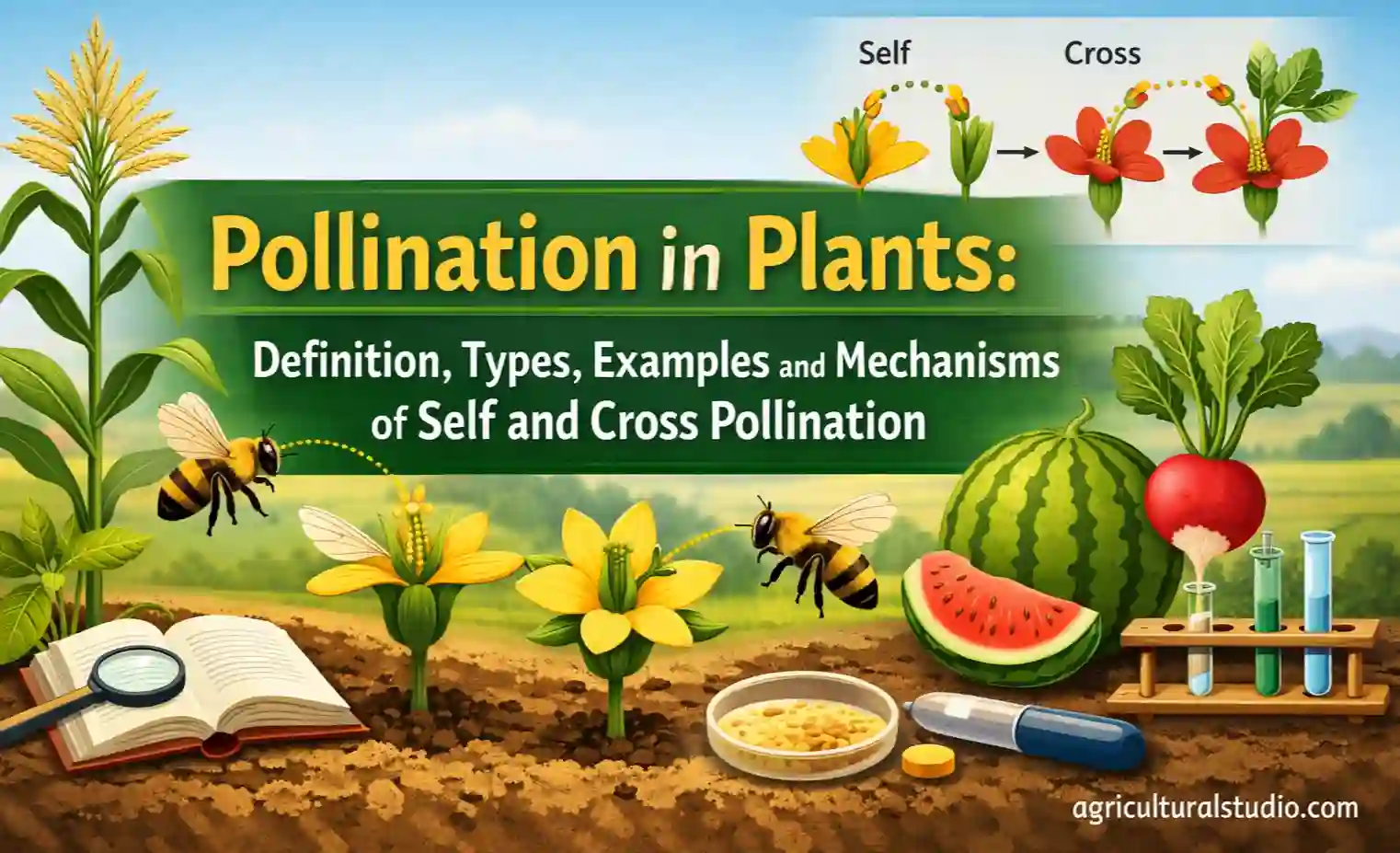
Pollination in plants is one of the most basic and important topics in agriculture and biology. Almost every crop we grow depends on it in some way. If you understand pollination properly, many other topics like fertilization, seed formation, breeding, and hybrid production become much easier.
Let us go step by step and understand pollination in very simple words, just like a teacher explaining in class.
Table of Contents
This topic is part of our Horticulture Notes series for agriculture students
What is Pollination in Plants ?
Pollination in Plants is the transfer of pollen grains from the anther (male part) to the stigma (female part) of a flower.
In simple terms, pollen must reach the stigma for fertilization to happen. Without pollination, seeds and fruits cannot form.
For example, in crops like tomato or wheat, pollination happens quietly inside the flower. In crops like watermelon or cucumber, insects help in pollination.
Types of Pollination in Plants
Pollination in Plants is mainly of three types:
- Self-pollination
- Cross-pollination
- Often cross pollination
1. Self-Pollination (Autogamy)
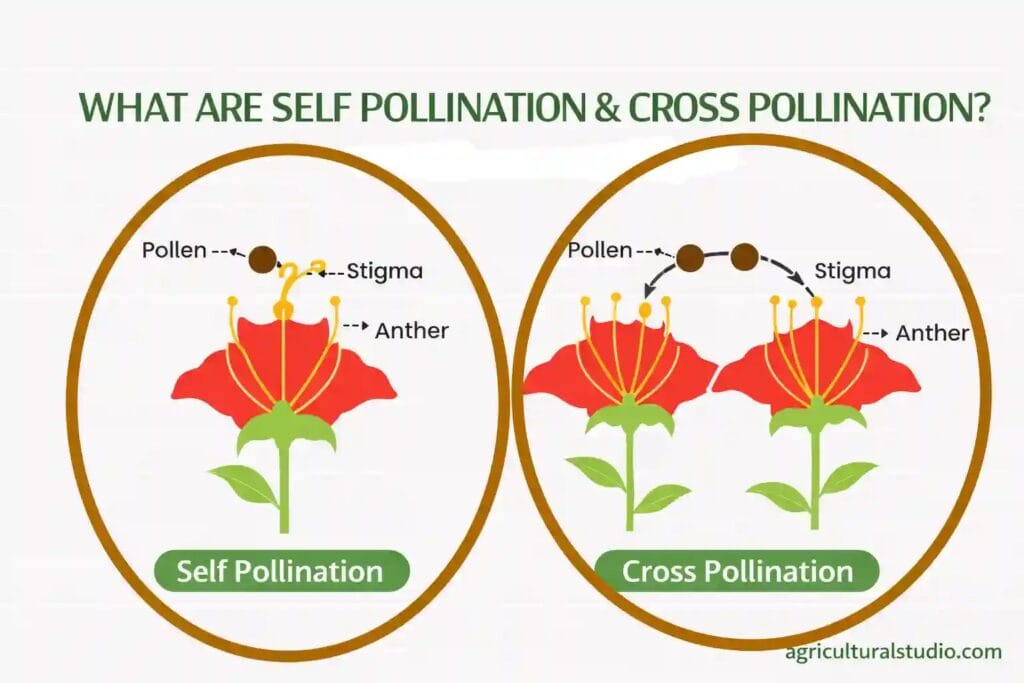
Self-pollination means pollen is transferred from the anther to the stigma of the same flower.
- Usually, cross-pollination is less than 5%
- It is the closest form of inbreeding
- It leads to homozygosity, meaning similar genetic characters are maintained generation after generation.
This type of pollination is common in crops where flowers are designed to pollinate themselves.
Examples: Tomato, Brinjal, Okra, Soybean, Potato
These crops show very little variation because self-pollination maintains uniform characters. That is why farmers get similar plants every year.
Geitonogamy – A Special Case
Geitonogamy is another form of self-pollination.
Here, pollination occurs between two different flowers of the same plant.
Even though pollen moves from one flower to another, both flowers belong to the same plant. So genetically, the effect is same as autogamy.
This is why geitonogamy is also considered self-pollination.
2. Cross-Pollination (Allogamy)
Cross-pollination means pollen is transferred from the flower of one plant to the flower of another plant of the same species.
- About 30% or more cross-pollination may occur.
- It increases genetic diversity.
- Plants become more vigorous and adaptable.
This type of pollination is common in crops that depend on wind, insects, or other agents.
Examples: Radish, Cabbage, Spinach, Onion, Garlic, Muskmelon, Watermelon
In crops like watermelon, bees play a major role in carrying pollen from one plant to another.
3. Often Cross-Pollinated Crops
Some crops are normally self-pollinated, but due to wind or insects, 5% to 30% cross-pollination may occur.
Examples: Sorghum, Cotton, Safflower
These crops show some variation even though they are mainly self-pollinated.
Important Flower-Related Terms
Before going further, it is important to understand some basic flower terms that often come in exams.
Typical Flower
typical flower has four main parts: Sepals, Petals, Stamens (male organ), Pistil (female organ)
Among these, stamen and pistil are reproductive organs.
Complete Flower
A flower that has all four parts – sepals, petals, stamens, and pistil is called a complete flower.
Examples: Hibiscus, Soybean
Incomplete Flower
If a flower lacks one or more floral parts, it is called an incomplete flower.
Examples
- Grass family crops like paddy, maize, sorghum lack petals and sepals
- Buckwheat and sugar beet flowers lack petals
Perfect Flower
A flower that has both stamens and pistil is called a perfect flower.
Examples: Cotton, Wheat
Imperfect Flower
A flower that has only stamens or only pistil (not both) is called an imperfect flower.
Such flowers encourage cross-pollination.
Fertilization
Fertilization is the fusion of male and female gametes.
Pollination must happen first. After that, fertilization leads to seed and fruit formation.
Without fertilization, no yield is possible.
Mechanisms Promoting Pollination in Plants
Plants have developed special mechanisms to promote either self-pollination or cross pollination.
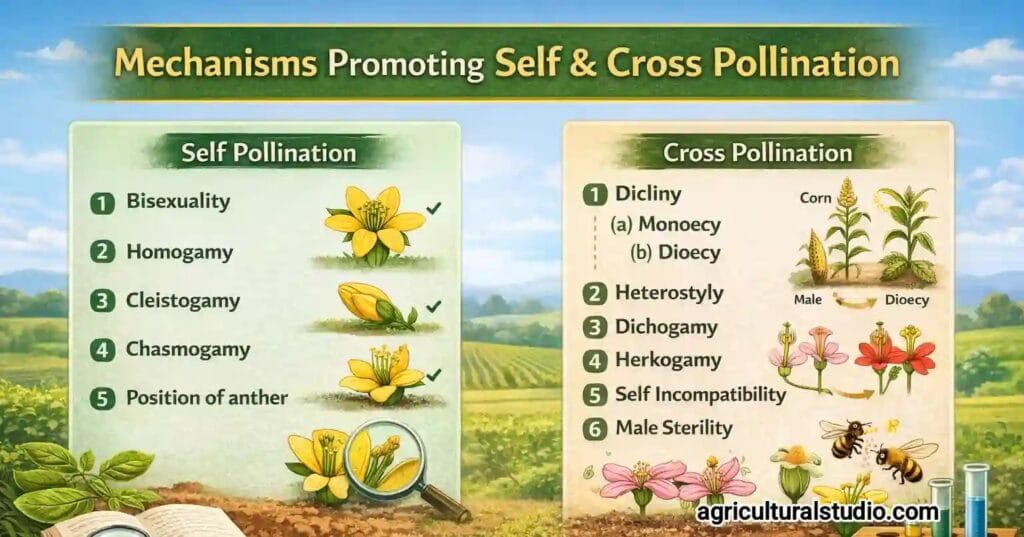
A. Mechanisms Promoting Self-Pollination
1. Bisexuality (Hermaphrodite)
When both male and female organs are present in the same flower, self-pollination becomes easy.
2. Homogamy
In homogamy, anther and stigma mature at the same time.
This timing helps pollen to fall directly on the stigma.
3. Cleistogamy
In cleistogamy, pollination and fertilization occur in an unopened flower bud.
- Flower never opens
- Self-pollination is guaranteed
Examples: Some varieties of wheat, Barley, Oats
This is a very safe method to maintain pure lines.
4. Chasmogamy
In chasmogamy, flowers open only after pollination is completed. Fertilization occurs just after opening.
5. Position of Anthers
Sometimes the structure of the flower itself ensures self-pollination.
- Stigma surrounded by anthers
- Examples: Tomato, Brinjal
- Stamen and stigma enclosed by petals
- Examples: Green gram, Black gram, Soybean, Chickpea, Pea
B. Mechanisms Promoting Cross-Pollination
1. Dicliny
Dicliny refers to unisexual flowers.
It has two types: Monoecy and Dioecy
(a) Monoecy
Male and female flowers are separate but present on the same plant.
Two Conditions of Monoecy:
- On the same inflorescence
- Examples: Mango, Castor, Banana
- On different inflorescences
- Examples: Cucurbits, Grapes, Strawberry, Cassava, Rubber
(b) Dioecy
Male and female flowers are present on different plants.
Examples: Papaya, Date palm, Spinach, Hemp, Asparagus
Gynodioecy
In gynodioecy:
- One plant bears both male and female flowers
- Another plant bears only female flowers
This system also promotes cross-pollination.
2. Dichogamy
In dichogamy, anther and stigma mature at different times in the same flower
This prevents self-pollination.
Types of Dichogamy
- Protogyny: Pistil matures before anther.
- Examples: Banana, Fig, Pomegranate, Bajra
- Protandry: Anther matures before pistil.
- Examples: Groundnut, Coconut, Aonla, Walnut, Maize
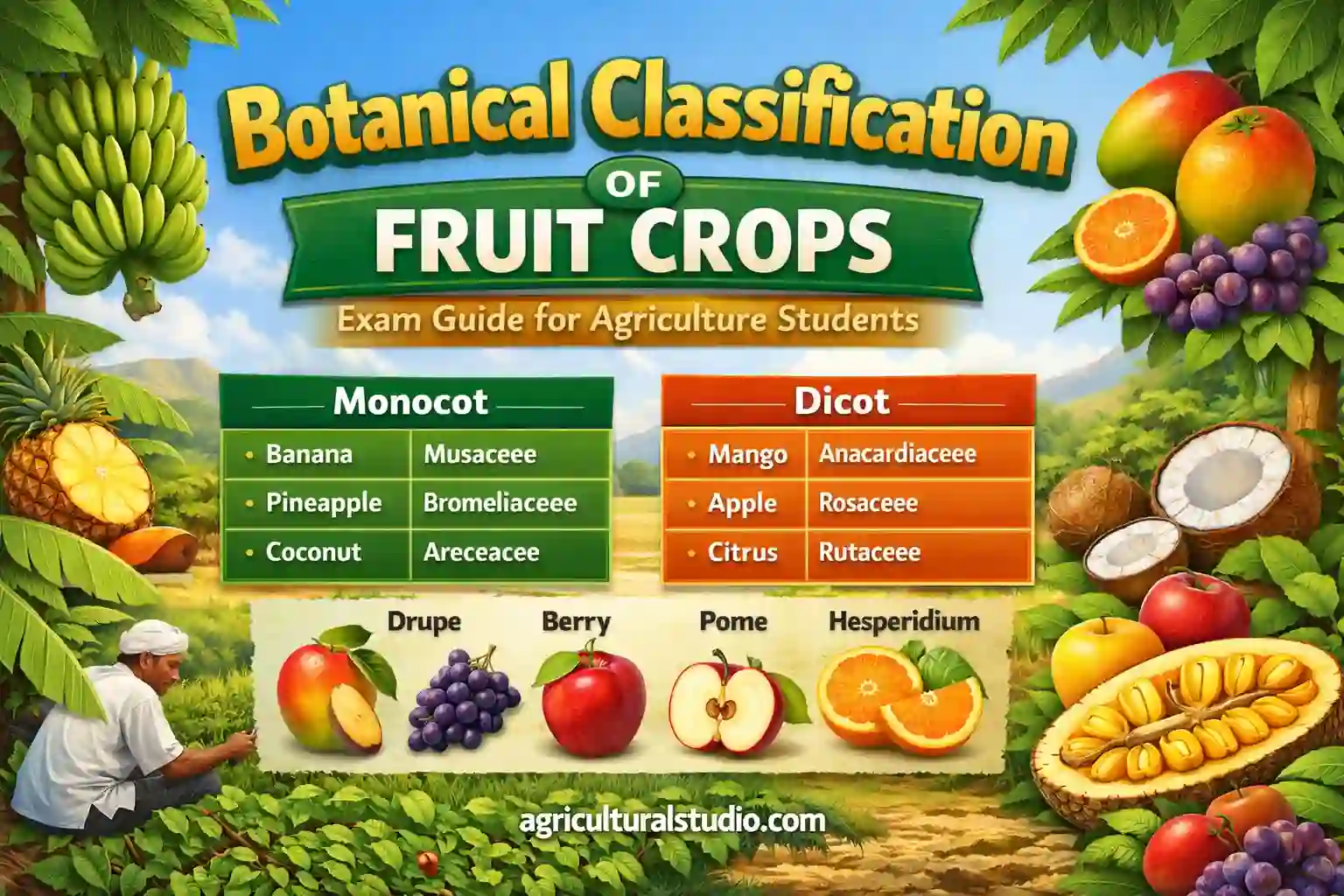
To understand fruit crop examples of dichogamy in detail, read our article on Classification of Fruit Crops.
3. Heterostyly
In heterostyly, style and filament lengths are different.
This physical difference promotes cross pollination.
Example: Linseed
4. Herkogamy
In herkogamy, physical barriers prevent self-pollination.
For example, a thin membrane around anthers stops pollen from reaching the stigma of the same flower.
5. Self-Incompatibility
In self-incompatibility, pollen may be fertile but fails to fertilize the same flower. This is a genetic mechanism that forces cross-pollination.
6. Male Sterility
In male sterility, pollen grains are non functional.
- Female part works normally
- Very useful in hybrid seed production
Many hybrid crops in India are produced using this technique.
Conclusion
Pollination in plants is the foundation of crop production. Whether a crop is self-pollinated or cross-pollinated decides its breeding method, variability, and yield potential. For agriculture students and competitive exam aspirants, understanding pollination with examples makes learning easier and scoring better.
If you remember the concepts with crop examples, you can easily answer MCQs and descriptive questions in exams.

Leave a Reply to Classification Of Fruit Crops In Horticulture | Complete PDF Guide Cancel reply